For Michigan enterprises operating multiple physical locations—whether it’s a credit union with branches across the Lower Peninsula, a healthcare system in Metro Detroit, or a restaurant group expanding from Grand Rapids to Traverse City—the traditional digital marketing rulebook has been rewritten. In 2026, dominance is no longer about managing individual keyword rankings; it is about managing Entity Consistency and Cross-Location Authority.
To rank #1 for competitive multi-location queries, a decentralized strategy is fatal. If an enterprise fails to prove E-E-A-T Consistency across all branches, AI citation engines (GEO) will de-prioritize the brand, assuming lack of operational trust.
This post provides the ultimate technical directive for Michigan multi-location brands, visualizing the optimized workflow required to manage a single source of truth across a complex operational footprint.
I. Defining Multi-Location Authority in 2026
The challenge is complex: how to prove to search engines and LLMs that a branch in Oakland County possesses the same high level of institutional trust and expertise as the headquarters in Ann Arbor. The answer lies in centralized technical governance.
A multi-location enterprise cannot operate without a unified “Enterprise Authority Pipeline,” which we conceptualize below:
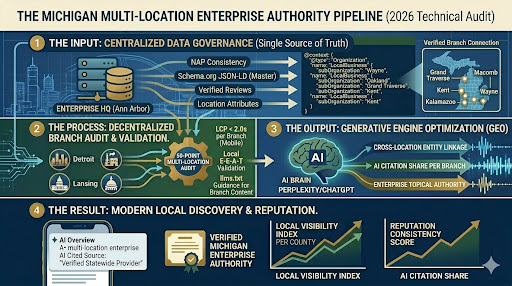
The Multi-Location Authority Flywheel (Image 22)
This infographic (Image 22) visualizes the four critical phases of the 2026 technical governance directive for Michigan multi-location enterprises. It shows how the data management flows to achieve Statewide Topical Authority:
- Layer 1: The Input (Centralized Data Governance): The foundation of authority is not content creation; it is data management. The pipeline starts with a master, decentralized database hosted at the Enterprise HQ (Ann Arbor). This database must hold the single source of truth for all NAP Consistency, Verified Reviews, and specific Location Attributes (e.g., specific medical procedures at the Detroit branch). The data is outputted as a validated, nested JSON-LD Schema (Master) file that explicit defines the relationship between the
Organizationand itssubOrganizationlocations. - Layer 2: The Process (Decentralized Branch Audit & Validation): This is the heart of the directive. A centralized technical audit engine (the multi-gear system derived from your Technical SEO Pillar, Image 0) executes a 50-point audit against every physical branch. Crucially, the visual highlights that this is a decentralized, mobile-first audit:
- LCP < 2.0s Check per Branch (Mobile): The fast hosting requirement from Image 18 is applied individually, ensuring a fast load in Oakland County as well as in Kalamazoo.
- Local E-E-A-T Validation per Branch: The expertise and authoritativeness defined by HQ are validated through consistent review sentiment management (as seen in the Traverse City AgTech Playbook, Image 8).
- llms.txt Guidance for Branch Content: The technical directives from Image 10 are used to prioritize high-value branch-specific semantically dense content for AI ingestion.
- Separate data streams connect this centralized audit to trusted Michigan entity hubs like the Detroit automotive tech corridor and Grand Rapids manufacturing hub (consistent with Image 1).
- Layer 3: The Output (Generative Engine Optimization – GEO): The verified consistency flows into the AI Brain (the core consistent with Image 0 and Image 6). The brain synthesizes the information, and the result is a massive increase in AI CITATION SHARE PER BRANCH. It recognizes the brand possesses both enterprise-level trust and hyper-local consistency.
- Layer 4: The Result (Modern Local Discovery & Reputation): The flywheel completes, showing that technical management directly fuels the visibility result:
- Search Domination: The enterprise is the definitive AI Cited Source: “Verified Statewide Provider” for complex, multi-location queries.
- Verified Michigan Enterprise Authority: The statewide certificate is earned.
- Performance Graphs: Upward trending graphs visualize the result: rising LOCAL VISIBILITY INDEX PER COUNTY (e.g., Wayne, Oakland, Grand Traverse, Kent) and a dominant REPUTATION CONSISTENCY SCORE.
Technical Multi-Location Checklist (The 2026 Directive)
- Implement a ‘Master’ JSON-LD Schema: Use nested properties to connect the main
Organizationentity to allsubOrganizationorLocalBusinessbranch locations using the correctPostalAddressandgeoproperties, and explicitareaServedvalues per branch. - Centralize Google Business Profile (GBP) Governance: GBP cannot be managed locally. Control all listings from HQ to ensure absolute Name, Category, and Attribute consistency, while implementing centralized sentiment analysis for all location reviews.
- Validate Mobile Speed per Branch: Implement regional hosting/CDN infrastructure to ensure the LCP < 2.0s threshold is met by a mobile user at every physical branch location.
- Create Localized ‘Answer-First’ Modules: Within each branch location page, structure the content to answer high-intensity conversational queries unique to that market (e.g., “Grand Rapids branch specific procedures vs. Traverse City”).
Leave a Reply