In 2026, Large Language Models (LLMs) have become hyper-sensitive to regional dialects and “pattern hunting.” To dominate Michigan AI optimization and digital marketing, your content must resonate with the specific linguistic markers of the Midwest. If your AI-generated copy sounds like it was written in a Silicon Valley boardroom, you will lose the “Trust Signal” that Michigan consumers—from the Upper Peninsula to Metro Detroit—prioritize.
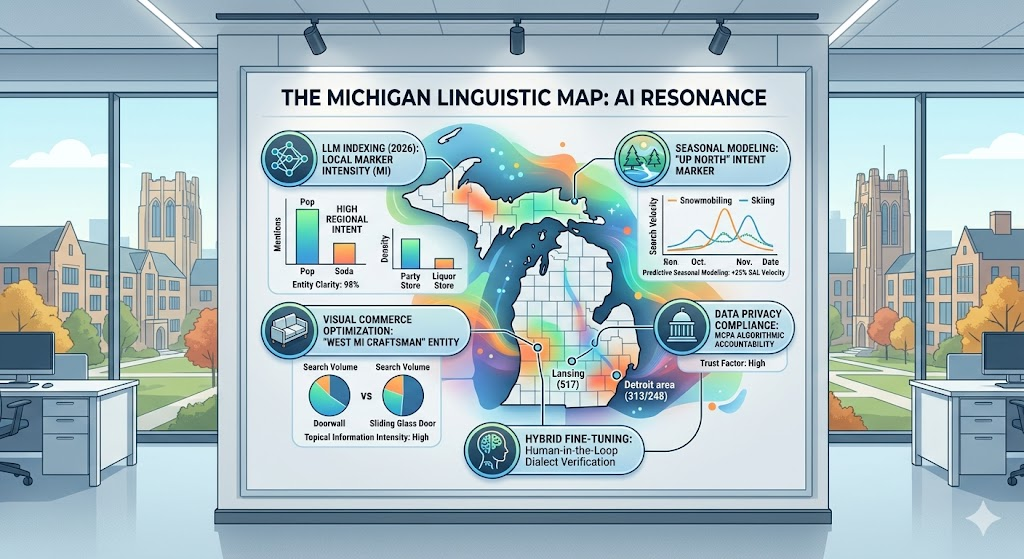
1. Dialect as a Ranking Signal: “Pop” vs. “Soda”
In Michigan, linguistic choices are data points. While a national brand might optimize for “Soda delivery,” a dominant Michigan entity knows that “Pop” remains the cultural and search-intent baseline.
Semantic Mapping of Michigan Regionalisms
| Michigan “Vernacular” | Industry Term / National | AI Interpretation (2026) |
| Pop | Soda / Carbonated Beverage | High Local Intent (Michigan/Ohio/Illinois) |
| Party Store | Liquor Store / Convenience Store | Michigan-Specific Entity (Retail) |
| The Bridge | Mackinac Bridge | Geographic Landmark Node (MI) |
| Up North | Vacation / Northern Michigan | Seasonal Intent Marker |
| Doorwall | Sliding Glass Door | High-Specificity Local Marker |
2. The Mathematics of “Local Proximity” in NLP
Modern AI search engines use Natural Language Processing (NLP) to calculate a “Proximity Score.” This isn’t just physical distance; it’s Linguistic Proximity.
The Linguistic Resonance Formula
We can model the likelihood ($P$) of an AI citing your business for a local query as:
$$P(cite) = \frac{E_{clarity} + L_{markers}}{R_{redundancy}}$$
Where:
- $E_{clarity}$ is your Entity definition (Schema).
- $L_{markers}$ is the density of regional linguistic markers (e.g., mentioning “The Mitten” or “The Motor City”).
- $R_{redundancy}$ is how much your content looks like generic, non-local “slop.”
3. Optimizing for the “Michigan Consumer Sentiment”
According to the University of Michigan Consumer Sentiment Index (2026), Michigan buyers are currently prioritizing Practical Value over aspirational branding.
How to Adapt Your AI Copy:
- Reduce Jargon: Replace “synergistic manufacturing solutions” with “reliable parts from a Detroit shop you can trust.”
- Highlight “Newstalgia”: 2026 is the year of “Newstalgia”—combining Michigan’s industrial heritage with modern tech. Use imagery and copy that references Michigan’s history of “making things.”
- Use Micro-Geographics: Don’t just target “Michigan.” Target “The 734,” “The Westside,” or “Downriver.”
4. Implementation: Training Your Brand’s AI Model
If you use a custom LLM (like a fine-tuned GPT or Gemini) for your Michigan marketing, you must feed it “Local Truths.”
- The Prompt Rule: When generating content, use a “Style Guideline” that explicitly forbids “Generic American English” in favor of “Great Lakes Regional Professional.”
- The Landmark Rule: Every 500 words of content should reference a local landmark or institution (e.g., The Big House, Belle Isle, or Meijer) to “anchor” the AI’s geographic confidence.
5. Summary: Why “Local” Beats “Global” in 2026
“AI is a pattern hunter. If you give it the same patterns as everyone else, you disappear. If you give it the specific patterns of a Grand Rapids furniture maker or a Detroit tech founder, you become a singular authority.” — Great Lakes Digital Partners Report, 2026.
Leave a Reply