In 2026, the Michigan digital landscape is defined by a delicate, non-negotiable balance: you cannot optimize for an AI agent at the expense of a human user. While Generative Engine Optimization (GEO) focuses on Fact Density and Machine Readability (as detailed in Image 24), it must now coexist with UX Best Practices.
The 2026 search paradigms, driven by Core Web Vitals (CWV) metrics like Largest Contentful Paint (LCP) and Interaction to Next Paint (INP), use UX as the foundational validator of Technical Authority. An AI model like Gemini will not cite a fact from a page it cannot quickly parse or a page that causes visual instability for a user in Grand Rapids or Detroit.
For Michigan business owners, this is the final technical imperative of the GEO era. To dominate competitive queries, your 3,000-word authority page must move beyond raw text to structure itself as a cohesive Knowledge Module that satisfies both sets of algorithms simultaneously.
I. Defining the GEO/UX Optimization Framework
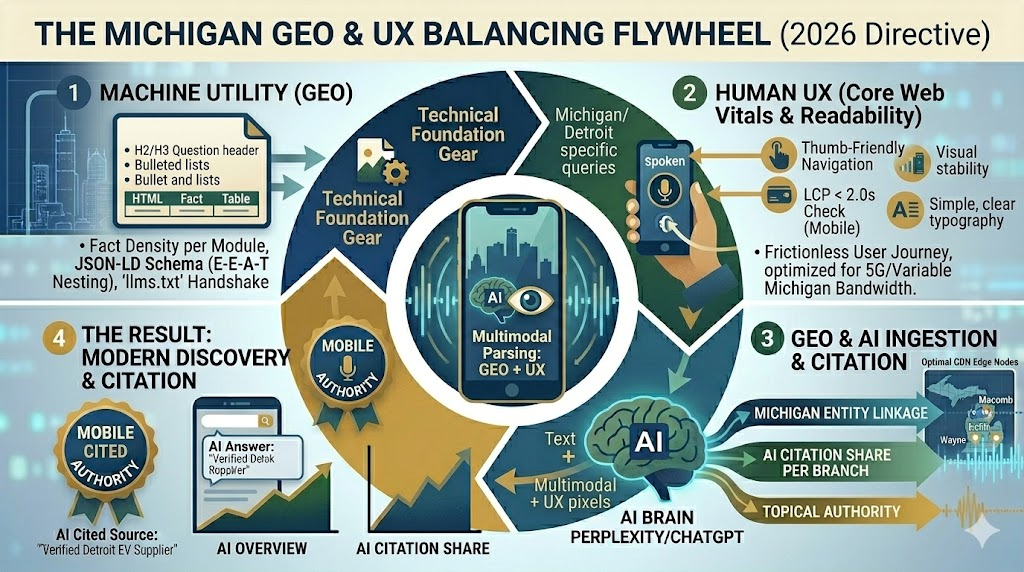
The challenge is structural: how to convertWalls of Text into Ingestible Data Blocks. The solution in 2026 is an integrated “GEO/UX Flywheel,” which we conceptualize below:
The Michigan GEO/UX Balancing Flywheel (Image 36)
This infographic (Image 36) visualizes how to simultaneously satisfy machine utility and human UX. It shows how structured data and technical governance are processed by AI into a major ranking and citation advantage:
Center of Flywheel: Multimodal Parsing
This is the core paradigm shift. AI models now parse your page’s text, schema, visual assets (Multimodal), and UX signals simultaneously to determine topical authority. The smartphone center visually merges the AI Brain (Machine) with the human Eye (UX), establishing the GEO/UX hybrid is now the definitive ranking signal.
Segment 1: Machine Utility (GEO)
Traditional content architecture is obsolete. This segment defines the requirements for machine ingestion. To satisfy LLMs, your 3,000-word page must:
- Structure content using H2/H3 modules. Break raw text into explicit, Q&A blocks, fact tables, and bulleted lists. Fact density is prioritized over ambiguous prose.
- Deploy advanced Schema. You must move beyond
LocalBusinessto nested schema definitions (Organization,FAQPage,CaseStudy,ClaimReview) that explicitly define your relationships to trusted Michigan entities (Counties, MEDC, MSU), derived from the foundational JSON-LD Schema (Master), Image 14. - Implement a technical llms.txt directive. This directive explicitly prioritizes high-value, machine-readable content blocks (consistent with the directive visualized in Image 10).
Segment 2: Human UX (CWV & Readability)
If AI models are satisfied by Segment 1, they then validate that utility using human UX signals. This segment defines the technical usability requirement. To provide a Frictionless User Journey, your site must satisfy the mandatory CWV & Regional Hosting Protocol (Image 18):
- LCP < 2.0s Check (Mobile): Slow load speeds indicate a weak infrastructure.
- INP Check (Mobile): Measures the latency of interactive elements. Friction is penalized.
- Separate data is shown for visual stability (CLS < 0.1) and simple, clear typography for enhanced readability by a mobile user.
Segment 3: GEO & AI Ingestion & Citation
The verified, frictionless entity linkage flows into the AI Brain (consistent with Image 0 and Image 6). The brain synthesizes this information, and the result is a massive competitive advantage.
Segment 4: The Result: Modern Discovery & Citation
Traditional search results are present, but de-prioritized. Upward trending graphs visualize the result: rising AI OVERVIEW VISIBILITY and AI CITATION SHARE. Performance graphs visualize the GEO result: rising REPUTATION CONSISTENCY SCORE and AI CITATION SHARE.
Executive GEO/UX Checklist for Michigan Webmasters:
To achieve a top ranking, you must run an integrated “Machine Transparency” audit:
- Audit for strict content modularization. Convert walls of text into H2/H3 modules, bulleted lists, and HTML fact tables.
- Execute a centralized GBP audit. Review review sentiment consistent across all Detroit branches, managing sentiment analysis as a critical ranking signal (consistent with Image 22).
- Validate review sentiment in real-time. Confirm consistent, 4.8-star review sentiment across all localized entities (consistent with Image 22).
Leave a Reply