In 2026, the Michigan B2B landscape is defined by a singular, non-negotiable metric: Verified Trust (E-E-A-T).
To rank #1 for “SEO and GEO best practices in Michigan“ and, crucially, to capture high-value citations from Generative Engine agents like Gemini and Perplexity, your organization cannot rely on a flat document. A simple blog post cannot prove you are the definitive B2B leader.
You must stop “writing content” and start Designing an Entity.
The goal of modern SEO is not just linear ranking; it is Citation Capture. You want the AI agent to select your business as the definitive answer for complex B2B queries like, “Who is the most trusted manufacturer in Michigan for nested mobility supply chain validation?” To achieve this, you must construct a cohesive, machine-readable Knowledge Graph of your business’s E-E-A-T.
This post provides the ultimate technical directive for Michigan enterprises, visualizing the layered technical “blueprint” required to build an entity that is indestructible to AI analysis.
I. Defining the Multi-Layer B2B Authority Pipeline
E-E-A-T in 2026 is not about a “Meet the Team” page. It is a comprehensive technical mandate that merges infrastructure, schema, content modularization, and third-party verification. This is the GEO Ingestion Protocol required to convert your abstract operational reality into machine-readable data blocks.
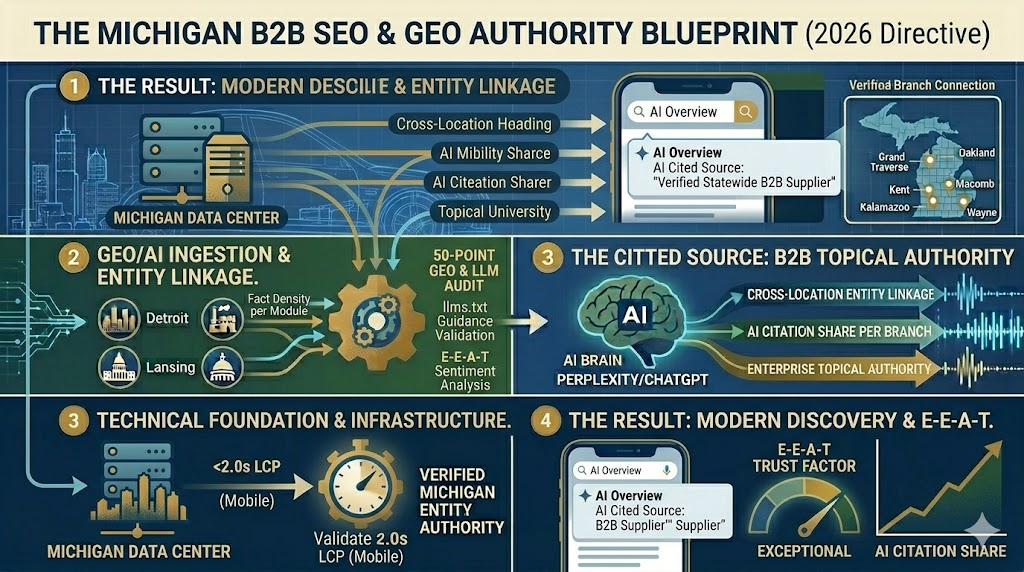
To visualize this process, we conceptualize the 2026 B2B Authority Pipeline as a specialized “stack” diagram:
The Michigan Authority Stack (Image 38)
This infographic (Image 38) visualizes how to build a dominant, cited B2B entity in the era of GEO. It breaks down the process into four distinct horizontal layers, starting with the technical base:
- Layer 1: Technical Foundation & Infrastructure (The Base): The entire stack rests on this foundation. Your B2B authority must be served fast to satisfy On-the-Go users and LLM crawlers.
- Michigan Data Center: The base layer is physically grounded. A server rack labeled ‘MICHIGAN DATA CENTER’ serves as the primary host. The speedometer gear (consistent with Image 0) validates that perfect <2s LCP (Mobile) threshold (Image 18).
- Layer 2: GEO/AI Ingestion & Entity Linkage (The Engine): Data streams flow from Layer 1 into the central auditing gear (derived from Image 0). This gear executes a 50-point GEO and LLM audit. The visual highlights four critical checks:
- **Factual Transparency Check:**AI models prioritize data that is verifiable and structurally clear (consistent with the modular approach defined in Image 32).
- JSON-LD Schema (Entity Definition): The engine validates the high-fidelity JSON-LD Schema (Master) defined in Image 14, explicit connecting the organization entity to other trusted Michigan entities (Counties, MEDC, MSU).
- Verified Citation Check: LLMs like Perplexity will not cite a fact without verification. The pipeline validates that your B2B case studies are supported by reputable external mentions or industry credentials.
- E-E-A-T Sentiment Analysis: AI agents execute real-time sentiment analysis of local reviews (Image 22) to evaluate trust and reputation. Separate data streams connect this engine to verified Michigan entity hubs (e.g., Detroit Mobility Tech, Image 1).
- Layer 3: The Cited Source: B2B Topical Authority (The Output): The verified consistency flows into the AI Brain (consistent with Image 0 and Image 6). The brain synthesizes this information and the result is the critical GEO metric that drives visibility: a massive increase in AI CITATION SHARE PER BRANCH.
- Layer 4: The Result: Modern Discovery & E-E-A-T (The Proof): Traditional search results are present, but de-prioritized. Performance graphs visualize the GEO result: rising E-E-A-T TRUST FACTOR and AI CITATION SHARE. The enterprise is the definitive AI Cited Source: “Verified Statewide B2B Supplier” for complex, multi-location queries.
II. Case Study: Detroit Manufacturing Entity Authority
To see this blueprint in action, consider how it applies to a typical Detroit-based manufacturing B2B supplier aiming to dominate AI conversational queries.
Vertical Validation vs. Horizontal Text
In 2026, an LLM will not cite a fact from a page it cannot quickly parse or a page that causes visual instability for a user. While a flat blog post might keywords like “Detroit manufacturing supplier,” the blueprint forces vertical validation:
Supplier Entity[PARTNERS WITH] ->OEM Entity(verified viaOEM partnership schema, Image 1)Supplier Entity[IS CERTIFIED IN] ->ISO/TS Certification StandardSupplier Entity[OPERATES R&D IN] ->Verified Oakland County Mobility Hub
The 2026 Competitive Advantage
When you merge flawless Technical CWV (<2s LCP) with deeply nested JSON-LD Schema (Master) entity definitions, you achieve two primary objectives:
- AI Citation Share: You provide the AI model with the most transparent and verified facts to ingest, summarize, and cite.
- Statewide Topical Authority: You ground your organization’s E-E-A-T in the local economy, connecting your business to the most reputable and relevant Michigan entity hubs (e.g., Grand Rapids Manufacturing, Image 1).
Executive Action Plan for Michigan B2B Brands
- Structure Content strictly as a dataset. Break your 3,000 words into explicit H2/H3 Q&A blocks, fact tables, and bulleted lists.
- Implement high-fidelity JSON-LD schema. Review all nested schema definitions (
Organization,FAQPage,CaseStudy,ClaimReview) with precise JSON-LD Schema (Master) definitions that explicitly define your relationships to trusted Michigan entities (Counties, MEDC, MSU). - Execute a GBP governance audit. Real-time review management across all Michigan locations (consistent with Image 22) ensuring absolute operational consistency for voice assistants.
Leave a Reply