To achieve a top ranking for “SEO and GEO best practices in Michigan“ in 2026, you must stop visualizing your web page as a flat document and start designing it as a structured data repository.
Traditional “blogging” is insufficient for modern visibility. Large Language Models (LLMs) and Generative Search Engines (GEO) do not read content sequentially; they ingest it in semantic chunks, looking for explicit answers, fact density, and structured relationships (Entities). If your 3,000-word authority page is just walls of text, it is un-scapable and therefore un-citeable by AI agents like Perplexity, ChatGPT, and Gemini.
This post provides the mandatory Content Architecture Directive for Michigan brands, visualizing the physical restructuring required to convert raw text into highly authoritative, machine-ready “Knowledge Modules.”
I. The Shift from Text to “Knowledge Modules”
In 2026, search relevance is calculated by multimodal parsing. AI models parse text, schema, visual assets (as seen in Image 16), and user sentiment simultaneously to determine a page’s total topical authority.
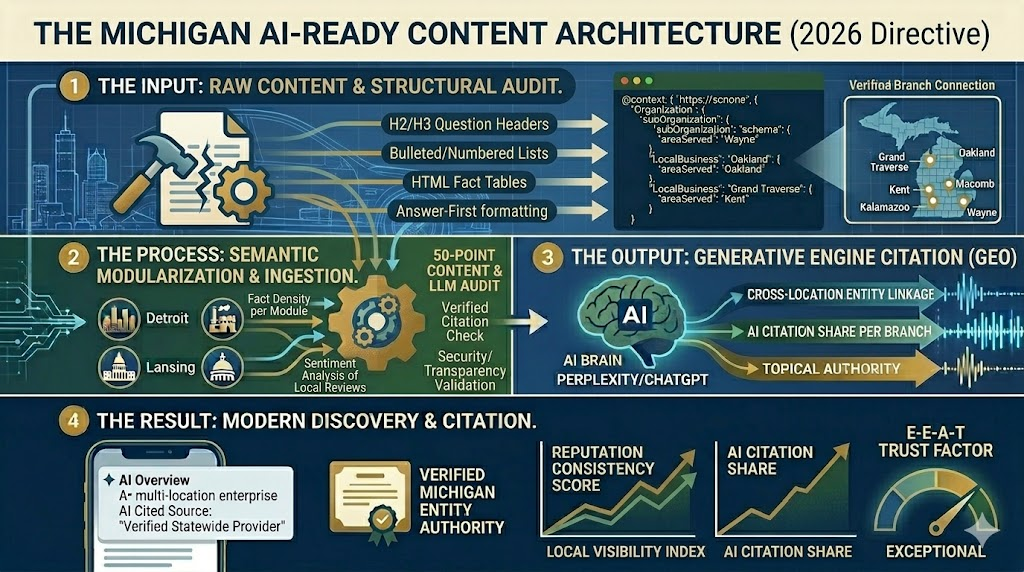
To satisfy these models, you must structure your content using Answer-First, Modular Architecture, which we conceptualize below:
The Michigan AI-Ready Flywheel (Image 32)
This infographic (Image 32) visualizes how to apply the 2026 content architecture directive. It shows how raw information is physically restructured into highly ingestible Knowledge Modules:
- Layer 1: The Input (Raw Content & Structural Audit): The process starts with un-optimized content. Icons of a hammer and gear visualize the breaking apart of large text blocks into explicit Knowledge Modules. Data streams flow out labeled H2/H3 Question Headers (the exact voice query defined in Image 28), Bulleted/Numbered Lists, HTML Fact Tables, and Answer-First Formatting (a concise, 50-word conclusive answer immediately following the header). Crucially, the process integrates highly nested JSON-LD Schema (Master) data (derived from Image 14) that explicitly links the modular text to trusted external Michigan entities (Counties, MEDC, MSU).
- Layer 2: The Process (Semantic Modularization & Ingestion): This is the mandatory technical verification. The multi-gear audit engine (derived from the original Technical SEO Pillar, Image 0) executes a specialized, 50-point GEO and LLM audit. The visual highlights six critical checks:
- Fact Density per Module: AI engines prioritize concise, verified data points over ambiguous prose.
- JSON-LD Entity Definition Nesting: Confirms the technical linkage (schema) grounds the content in real-world Michigan footprints.
- Verified Citation Check: For LLMs, a “fact” is only a fact if it can be cited. The content must link to primary, authoritative sources (e.g., Crain’s Detroit).
- Sentiment Analysis of Local Reviews: AI agents analyze review data (consistent with the Traverse City AgTech Playbook, Image 8) to evaluate local trust and reputation.
- Separate data streams connect this centralized audit to trusted Michigan entity hubs like the Detroit automotive tech corridor and Grand Rapids manufacturing hub (consistent with Image 1).
- Layer 3: The Output (Generative Engine Citation – GEO): The verified consistency flows into the AI Brain (Image 0). The brain synthesizes this information, and the result is a massive increase in AI CITATION SHARE PER BRANCH.
- Layer 4: The Result (Modern Discovery & Citation): The pipeline completes, showing that technical modularization directly fuels the citation result. A mobile search result with an AI answer box cites the enterprise:
AI Cited Source: "Verified Statewide Provider". Performance graphs visualize the GEO result: rising REPUTATION CONSISTENCY SCORE and AI CITATION SHARE. The certificate confirms the earned status of a VERIFIED MICHIGAN ENTITY AUTHORITY.
Your 2026 Content Architecture Action Plan
To dominate GEO and voice SEO in Michigan, you must enforce this technical modularity ruthlessly across your domain:
- Structure every page into H2/H3 modules. A 3,000-word page should have at least 20 explicit question-based headers with immediate conclusive answers.
- Utilize fact tables. Do not describe comparisons or metrics in prose; use HTML tables to present structured data.
- Validate review sentiment per module. Consistently manage 4.8-star review sentiment across all localized entities (consistent with Image 22).
- Deploy nested Schema. Use advanced JSON-LD Schema (Master) to explicitly nest
subOrganizationlocations and connect your expertise to external authoritative entities via thesameAsproperty.
Leave a Reply