By 2026, the baseline requirement for SEO and GEO best practices in Michigan has moved beyond high-quality content; it now demands high-fidelity data. To transition from being merely visible on a search results page to being a definitive, cited source in an AI Overview, your domain must speak the native language of Large Language Models (LLMs): Schema.org structured data (JSON-LD).
Schema is not just about earning rich snippets (though that remains a benefit). It is the mechanism by which you connect your ambiguous text (e.g., “We are a top Detroit automotive supplier”) into explicit, verifiable Entities (e.g., Supplier Entity [PARTNERS WITH] -> Ford Motor Company Entity).
For Michigan business owners, mastering schema nesting is the single most important technical imperative of the GEO era. It is how you ground your operation in the physical and economic reality of the Great Lakes State, building the irrefutable Trustworthiness (E-E-A-T) that AI models demand.
I. The Strategic Function of Schema: Building the Entity Graph
Search engines and LLMs are moving from “strings” (keywords) to “things” (entities). An entity is a concept that is distinct, defined, and uniquely identifiable. Schema.org provides the standardized vocabulary to define these entities and, crucially, the relationships between them.
For a Michigan business, your schema strategy must establish three core entity connections:
- Geographic Grounding: Connecting your
PostalAddressto specific MichiganAdministrativeAreaentities (counties, cities, the state itself). - Sector Alignment: Defining your business type (e.g.,
AutomotiveBusiness,ManufacturingBusiness) and its specialized competencies (knowsAbout). - Reputation & Trust: Linking your organization to authoritative external entities (e.g., the Michigan Economic Development Corporation (MEDC), the Michigan Chamber of Commerce, or Michigan State University) via the
sameAsproperty.
We visualize this process as an “Authority Pipeline,” where raw schema inputs are processed into the explicit entity relationships that fuel AI citations:
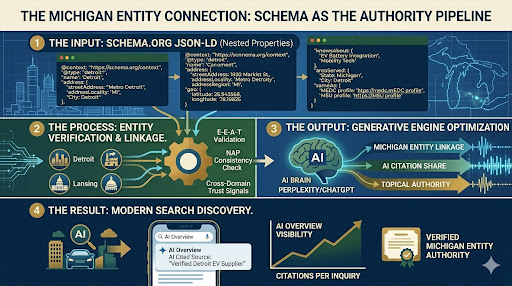
II. Case Study: The Michigan Authority Pipeline (Image 12)
This infographic (Image 12) illustrates how schema transforms foundational SEO into advanced GEO. It visualizes the flow of data for a Detroit-based automotive B2B supplier.
Layer 1: The Input (Schema.org JSON-LD)
The base of all technical authority is the schema code block itself. The visual highlights critical nested properties that grounding the business in Michigan:
@contextand@type: Defines the business as aManufacturingBusinessandLocalBusiness.addressLocality(Detroit) andaddressRegion(MI): This is the mandatory Local SEO footprint required for any Michigan search ranking.geo(latitude and longitude): Provides absolute spatial certainty.knowsAbout: Lists high-fidelity semantic competencies like “EV Battery Integration” and “Mobility Tech,” matching the sector-specific clusters established in your primary entity map (Image 1).areaServed: Explicitly defines the footprint (State of Michigan and City of Detroit).sameAs: This is the critical “Reputation Connector.” In 2026, it is mandatory to link your profile to established, authoritative Michigan entities to build Trust (E-E-A-T). By including links to your MEDC profile and your MSU collaboration page, you are effectively borrowing their institutional authority for your knowledge graph.
Layer 2: The Process (Entity Verification & Linkage)
Data from the code block flows into the Verification Gear (the same Technical Foundation gear from Image 0). Here, the LLM processes the inputs to validate the E-E-A-T of the domain:
- NAP Consistency Check: The name, address, and phone number (NAP) data must be consistent across all other Michigan industry directories.
- Cross-Domain Trust Signals: The
sameAslinks are followed to confirm that the business is indeed recognized by MEDC and MSU.
The gear is visually surrounded by icons representing key Michigan entities: the Lansing capitol building, a Grand Rapids manufacturing hub, and a university dome (consistent with the entity hubs in Image 1).
Layer 3: The Output (Generative Engine Optimization – GEO)
The validated entity linkage flows into the active AI Brain (consistent with Image 0 and Image 6). The brain synthesizes the information, and the result is a massive competitive advantage for the business:
- MICHIGAN ENTITY LINKAGE: The domain is now definitively connected to the local economic ecosystem.
- AI CITATION SHARE: The LLM now trusts the domain and begins to cite it as the primary source of truth for queries like “Verified Detroit EV Supplier.”
- TOPICAL AUTHORITY: The combined entity signals prove to the model that your domain is not just about manufacturing, but specifically the expert on Detroit automotive tech.
Layer 4: The Result (Modern Search Discovery)
The pipeline completes, and the user experience is revolutionized. The visual contrast in Image 12 clearly demonstrates the outcome of advanced GEO:
- Search Result with AI Overview: Traditional SERP visibility is present, but it is overshadowed by a prominent AI answer box that cites the supplier:
AI Cited Source: "Verified Detroit EV Supplier". - Performance Graphs: Upward-trending graphs visualize the core result: a dramatic increase in AI Overview Visibility and Citations Per Inquiry, directly driven by the flawless technical execution of schema nesting.
Leave a Reply