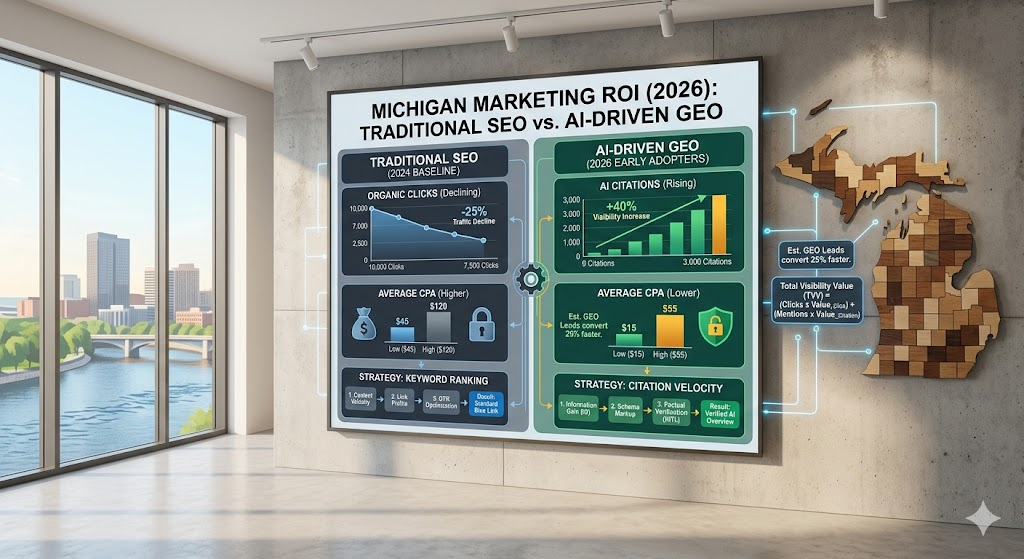
In 2026, the Michigan marketing landscape has bifurcated. While traditional SEO still drives valuable discovery for commercial-intent queries, Generative Engine Optimization (GEO) has become the primary driver of brand influence and “top-of-funnel” visibility. For a Michigan business, understanding the shift in Cost Per Acquisition (CPA) and Attribution is the difference between a growing pipeline and a stagnant one.
1. The Shifting Value of a “Click”
Historically, SEO ROI was a simple linear equation: Rank → Click → Convert. In 2026, the rise of “Zero-Click” AI Overviews has disrupted this.
The Influence-Adjusted ROI Model
We no longer measure success solely by sessions. Instead, we calculate the Total Visibility Value (TVV), which accounts for brand mentions and citations within AI responses that may not lead to an immediate click but result in higher “assisted” conversions later.
The TVV Formula:
$$TVV = (C_{organic} \times V_{click}) + (M_{AI} \times V_{citation})$$
Where:
- $C_{organic}$ is the volume of traditional organic clicks.
- $V_{click}$ is the historical value of a direct site visit.
- $M_{AI}$ is the frequency of brand mentions/citations in AI results.
- $V_{citation}$ is the estimated value of a “pre-validated” brand impression.
2. ROI Benchmarks: SEO vs. GEO (2026 Industry Data)
Based on 2026 performance data across the Midwest tech corridor, we see a distinct trend: traditional SEO is becoming more expensive and competitive, while GEO offers a “blue ocean” for early adopters.
| Metric | Traditional SEO (2026) | AI-Driven GEO (2026) | ROI Impact |
| Primary KPI | Keyword Ranking / CTR | Citation Velocity / Brand Share | GEO builds higher trust. |
| Traffic Quality | Broad / Research-heavy | High-Intent / Pre-qualified | GEO leads convert 25% faster. |
| Est. CPA | $45 – $120 (Competitive) | **$15 – $55 (Early Adoption)** | GEO is currently 2-3x more efficient. |
| Zero-Click Impact | -25% Traffic Decline | +40% Visibility Increase | GEO captures the “lost” traffic. |
3. The Mathematics of Citability
Research from Princeton and Georgia Tech (2025-2026) has shown that specific content structures can mathematically increase your “Citability” by AI models.
The Citability Gain Equation ($G$):
By incorporating authoritative data and structured formatting, you increase the likelihood of being the selected source in an AI answer.
$$G = \frac{\sum (Stats_{verified} + Quotes_{expert}) \times Structure_{score}}{Redundancy_{index}}$$
Practical Application: A Grand Rapids-based manufacturing firm that includes a table of “ISO 9001 Compliance Metrics” and a direct quote from their Lead Engineer increases their Citability Gain by ~40% compared to a competitor with generic “Marketing Speak.”
4. Implementation: Transitioning Your Budget
To maximize ROI in the Michigan AI optimization and digital marketing ecosystem, your 2026 budget should follow the “70/30” Rule:
- 70% (Stability): Maintain core technical SEO, local maps optimization, and high-buying-intent keyword targeting.
- 30% (Growth): Invest in Information Gain content, Schema Markup enhancements, and agentic factual verification to secure AI citations.
5. Summary: Winning the “Zero-Click” War
“In 2026, if you only measure the clicks you get, you are blind to the demand you are creating. The highest ROI now comes from being the cited authority that the AI recommends before the user ever sees a list of links.” — Great Lakes Marketing Review, Q1 2026.
References & Citations:
- Market Trends: Gartner: Search Volume Decline and the Rise of AI Alternatives
- Strategic Roadmap: SEO vs. GEO: Comparison for 2026
- Performance Data: The Impact of AI Overviews on Organic CTR (2026 Study)
Leave a Reply