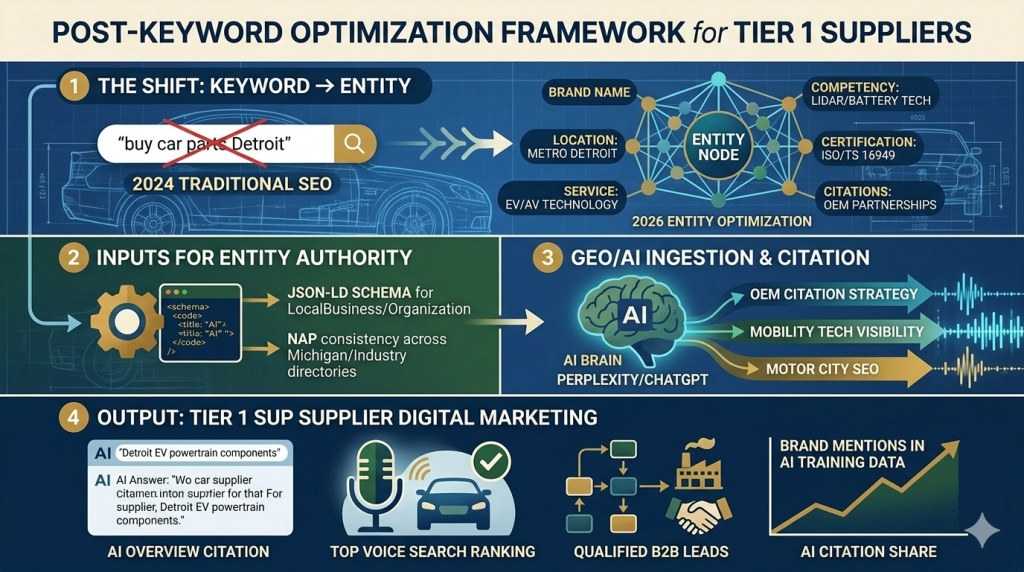
In 2026, the Detroit automotive SEO landscape has fractured. The traditional model of optimizing a Tier 1 supplier’s website to rank for generic product terms (e.g., “Detroit brake pads”) is functionally obsolete. The shift toward Electric Vehicles (EV) and Autonomous Vehicles (AV) has created a new competitive reality: a semantic battle where visibility is no longer defined by keywords, but by Entity Authority.
For the major Tier 1 suppliers in Metro Detroit, traditional digital marketing is no longer enough. The goal is now twofold:
- Rank in traditional Google SERPs for high-value B2B queries.
- Be Cited by Generative AI (GEO) engines like Gemini, ChatGPT, and Perplexity when an OEM asks, “Who is the leader in Detroit for solid-state battery integration?”
This post details the strategic pivot from keyword matching to entity linkage required to dominate the Motor City mobility tech corridor.
Part I: The Fall of Traditional Keywords for Detroit Automotive
The limitations of 2024-era SEO for B2B automotive suppliers are now clear. Keywords like “Detroit automotive parts supplier” generate too much noise. AI engines do not look for keywords; they look for facts and verified relationships between entities.
The Old Approach: Detroit Automotive SEO (2024)
- Focus: Page-level optimization of a single product page for “Detroit EV powertrain components.”
- Result: The page ranks #5 in traditional results, below major directory listings and aggregated industry reports.
- AI Ingestion: The LLM cannot distinguish this supplier from 50 others, so it offers a generic answer without a specific citation.
The New Approach: Entity Linkage (2026)
To understand this shift, we conceptualize the 2026 Tier 1 optimization framework in Image 6.
Layer 1: The Shift (Keyword -> Entity)
Traditional SEO is a linear, page-based model. Entity Optimization is a non-linear, semantic model where you must prove to the search engine that your “Supplier Entity” is deeply connected to other trusted, verified Detroit automotive entities. You must build a knowledge graph of relationships:
Supplier Entity[PARTNERS WITH] ->Detroit OEM Entity(e.g., GM, Ford, Stellantis)Supplier Entity[IS CERTIFIED IN] ->EV Battery Safety StandardSupplier Entity[OPERATES R&D IN] ->Oakland County Mobility Hub
Part II: Execution: Building Tier 1 Supplier Entity Authority
Domination in 2026 requires executing on the three strategic pillars established in your primary strategy overview.
Pillar 1: Local Michigan Entity Linkage
As illustrated in Image 6 (Layer 2), you must use advanced technical SEO to anchor your entity geographically. Your schema cannot just say you are in Detroit; it must explicitly serve the local automotive ecosystem.
Use nested JSON-LD schema to explicitly link your business entity to major Detroit auto players. A simple LocalBusiness schema is insufficient for a Tier 1 supplier; you must use AutomotiveBusiness or ManufacturingBusiness properties with deep geographical targeting:
JSON
{
  "@context": "https://schema.org",
  "@type": "ManufacturingBusiness",
  "name": "Motor City Mobility Tech",
  "areaServed": [
    {
      "@type": "AdministrativeArea",
      "name": "Metro Detroit"
    },
    {
      "@type": "City",
      "name": "Detroit"
    }
  ],
  "sameAs": [
    "https://www.linkedin.com/company/motor-city-mobility-tech/",
    "https://www.medc.gov/detroit-auto-innovators/"
  ],
  "knowsAbout": ["EV Battery Integration", "LIDAR Systems", "AV Safety Compliance"]
}
Pillar 2: Technical SEO Foundation & Schema Verification
LLMs trust data that is structured. Image 6 highlights that perfect Core Web Vitals (speed and stability) are prerequisites. Furthermore, specialized schema like Product markup for EV components and Event markup for major auto show presence (like NAIAS in Detroit) must be flawless. If an AI cannot scrape your site structure, it cannot cite your facts.
Pillar 3: Generative Engine Optimization (GEO): The OEM Citation Strategy
This is the most critical shift. Your content must be engineered for Machine Readability and Cite-ability. AI engines prioritize data points, case studies, and structured answers.
To be cited as the leader in “Detroit EV Powertrain,” you must execute an OEM Citation Strategy:
- Content Architecture: Revise existing 3,000-word product pages into modular Q&A blocks (as described in your main guide).
- Old H2: Our AV Capabilities.
- New H2: How is Motor City Mobility Tech optimizing AV sensors for adverse Detroit weather?
- Third-Party Verification: LLMs evaluate E-E-A-T based on what other domains say about you. Strategic Digital PR with trusted industry publications like Automotive News (Detroit based) is non-negotiable. An unsponsored, factual mention in Crain’s Detroit Business carries 10x the weight of a paid backlink in the GEO era.
“The successful Tier 1 Supplier in 2026 is not the one with the most backlinks, but the one that the AI can most accurately verify as being a trusted Detroit OEM partner.” — Search Engine Land Annual Report 2026.
Part III: The 2026 Detroit Automotive Visibility Result
The final layer of Image 6 visualizes the output of this integrated entity strategy. When you successfully merge localized Michigan identity with technical SEO and GEO content architecture, the result is dominating Mobility Tech Visibility:
- AI Overview Citation (GEO Success): Your brand is the definitive cited source for high-intent B2B conversational queries.
- Top Voice Search Ranking: Optimizing for long-tail, conversational queries captures the critical “on-the-go” search.
- Qualified B2B Leads: Your visibility is laser-targeted to the OEMs looking for your specific validated competency.
Leave a Reply