In 2026, the Michigan digital landscape is no longer flat. The explosion of Multimodal search—where users integrate text, voice, and especially Visual Search (e.g., Google Lens, Apple Vision)—means that optimizing text alone is a strategy for invisibility.
To rank #1 for competitive Michigan queries, your 3,000-word authority page must move beyond text to optimize every pixel. In the GEO era, AI models parse visual assets simultaneously with text and schema to build a cohesive multimodal knowledge graph of your domain.
This post details the mandatory Multimodal Visual SEO Directive for Michigan brands, visualizing the integrated strategy required to capture visual intent and capture AI citations.
I. Defining Multimodal SEO in Michigan (2026)
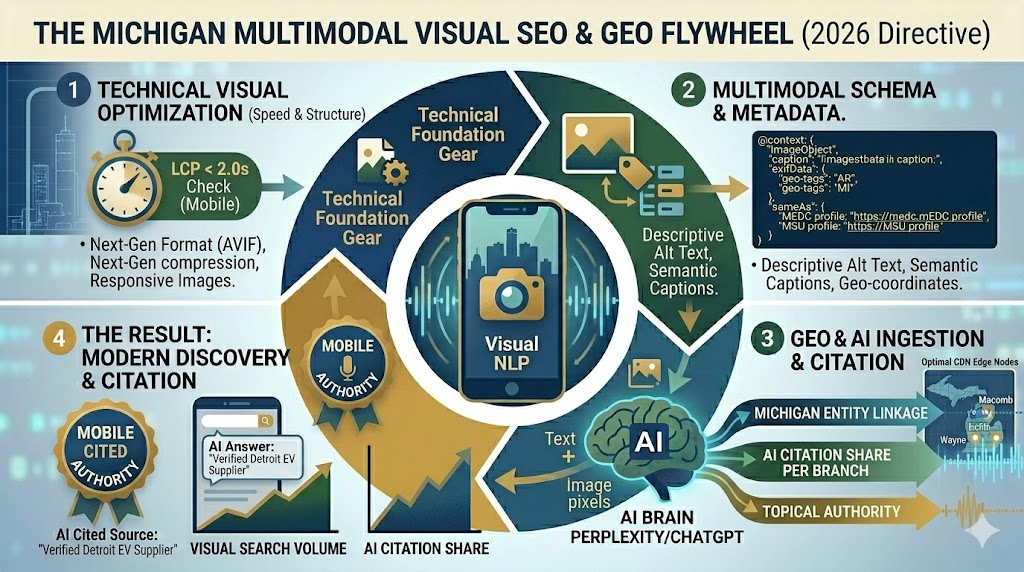
The challenge is complex: how to prove to an AI engine that your (https://www.google.com/search?q=./image_8.png) is not just a stock photo, but a verified E-E-A-T asset. The solution in 2026 is an integrated “Multimodal Visual Flywheel,” which we conceptualize below:
The Michigan Visual SEO Flywheel (Image 34)
As visualized above, a successful multimodal strategy in Michigan is not linear; it is a circular reinforcement:
Segment 1: Technical Visual Optimization (Speed & Structure)
The foundation of visual authority is technical agility. Your visual assets must adhere to the Technical SEO Pillar (Image 0) and the Regional Hosting Directive (Image 18):
- LCP < 2.0s Check (Mobile): Slow-loading images are devastating. Audit for mobile CWV to ensure an optimal user experience (consistent with the On-the-Go User Playbook, Image 20).
- Next-Gen Formats (AVIF): Use advanced compression and responsive image techniques to ensure fast delivery over variable Michigan 5G bandwidth. If the visual fails the speed test, the flywheel never starts.
Segment 2: Multimodal Schema & Metadata
This segment converts an image into structured data. You must ground your visual assets using advanced Multimodal Schema:
- Nested JSON-LD (ImageObject): Schema.org structured data must explicitly define the image’s
caption,exifData(geo-tags), and use thesameAsproperty to link the visual to verified Michigan entities (Counties, MEDC, MSU), derived from the foundational JSON-LD Schema (Master), Image 14. - GEO-coordinates: The image metadata (EXIF) must include precise Michigan latitude and longitude to provide absolute spatial certainty (consistent with the Traverse City AgTech Playbook, Image 8).
- Descriptive Alt Text & Semantic Captions: AI models ingestion is seamless when alt text and captions are highly descriptive and contain the necessary LSI keywords (Image 3).
Segment 3: GEO & AI Ingestion & Citation
The verified technical structure and schema flow into the active AI Brain (consistent with Image 0 and Image 6). The brain synthesizes this information, and the result is a massive competitive advantage.
Segment 4: The Result: Modern Discovery & Citation
Traditional search results are present, but de-prioritized. Upward trending graphs visualize the result: rising VISUAL SEARCH VOLUME and AI CITATION SHARE. The enterprise is the definitive AI Cited Source: “Verified Statewide Provider” with a contextually optimized image.
Key Executive Visual SEO Directives for Michigan Brands:
To dominate multimodal discovery and GEO, your authority page must achieve a perfect “Multimodal Visual Authority” audit:
- Stop using un-optimized stock photos. Every image must be a verified E-E-A-T asset.
- Run a comprehensive visual audit. Check mobile CWV (LCP < 2.0s) and bandwidth performance (consistent with Image 18).
- Execute advanced Schema nesting. Use the JSON-LD Schema (Master) file (derived from Image 14) to link every image (
ImageObject) to trusted external Michigan entities via thesameAsproperty.
Leave a Reply