In the competitive landscape of Western Michigan, specifically the manufacturing and medical device hubs of Grand Rapids, general “authority” is no longer enough. To capture the top 1% of B2B search traffic and AI citations, you must achieve Sector-Niche Domination.
Generative engines like Perplexity and ChatGPT prioritize sources that demonstrate deep, specialized technical knowledge over broad generalists. This means your digital footprint must be architected to prove you are the definitive expert in a specific vertical—whether that is furniture supply chain logistics, medical device component fabrication, or office system engineering.
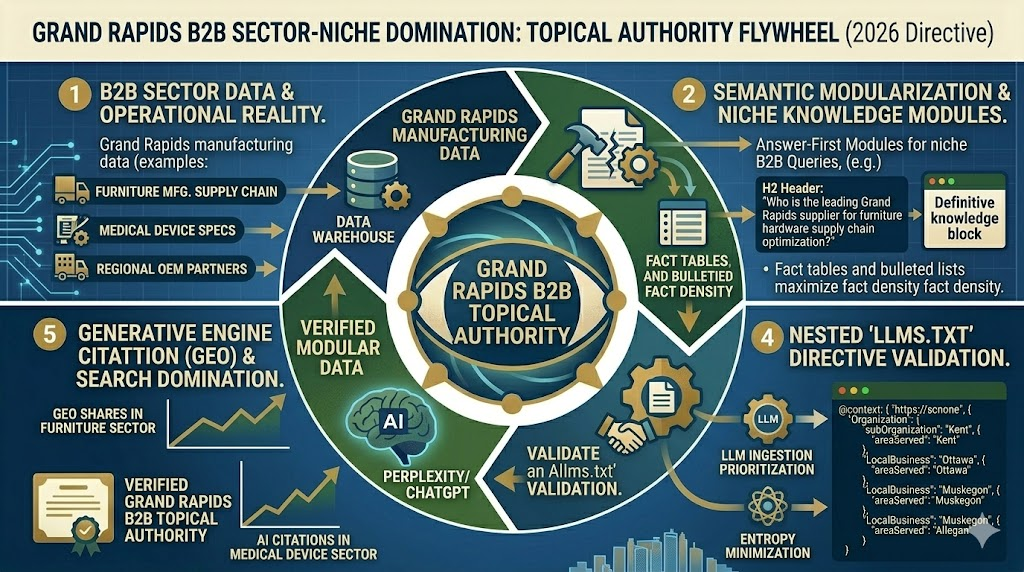
I. The Grand Rapids Topical Authority Flywheel
To move from being a “vendor” to a “cited authority,” you must implement a specialized technical and content strategy designed for B2B machine ingestion.
Segment 1: B2B Sector Data & Operational Reality
Dominance begins with raw data. AI engines look for evidence of your real-world operations in the Kent County area. Your digital assets must integrate specific, verifiable data points:
- Vertical Integration Proof: Documented supply chain flows for furniture manufacturing.
- Technical Specifications: Granular data on medical device tolerances and ISO-certified fabrication processes.
- Regional OEM Partnerships: Verified connections to Tier 1 and Tier 2 partners within the Grand Rapids ecosystem.
Segment 2: Semantic Modularization & Knowledge Modules
You must physically restructure your content into “Knowledge Modules” that provide immediate answers to niche B2B queries.
- Answer-First Formatting: Use H2 headers that mirror high-intent industry questions, such as “Who is the leading Grand Rapids supplier for furniture hardware supply chain optimization?”
- Fact Density: Immediately follow headers with 50-word definitive knowledge blocks. Use HTML fact tables and bulleted lists to maximize the amount of data per pixel, making it easy for AI to “copy-paste” your expertise into a generated answer.
Segment 3: Nested Machine Handshake (llms.txt)
To ensure AI agents find your most valuable data first, you must validate a specialized machine handshake. By deploying an llms.txt file, you explicitly guide AI crawlers toward your “Fact-Dense” directories while de-prioritizing fluff. This minimizes “semantic entropy” and ensures the AI model sees you as a precise, organized authority.
Segment 4: Sector-Specific Entity Linkage
Using advanced structured data (Schema), you must ground your business in the local economy. This involves nesting your organization within specific Grand Rapids geographic and industry hubs:
- Area Served: Explicitly defining service areas in Kent, Ottawa, and Muskegon counties.
- Topic Linkage: Using schema to link your domain to verified external authorities like the Michigan Economic Development Corporation (MEDC) or specialized Grand Rapids industry associations.
II. The Result: GEO & Search Domination
When this flywheel is fully operational, the result is a measurable shift in how your business is discovered:
- AI Citation Share: Your brand becomes the primary “Cited Source” in AI Overviews for specialized West Michigan manufacturing queries.
- Topical Authority Score: You earn a “Verified” status in the eyes of the algorithm, leading to higher rankings in traditional search and higher recommendation frequency in conversational AI.
- Sector-Specific Growth: Upward-trending metrics in GEO Shares for the furniture or medical device sectors, proving your technical investment has translated into market dominance.
B2B Executive Action Plan:
- Audit for Fact Density: Remove ambiguous marketing prose and replace it with technical tables and modular Q&A blocks.
- Deploy Localized Schema: Ensure your code explicitly connects your business to Grand Rapids-specific geographic and industrial entities.
- Optimize for Multimodal Search: Ensure technical drawings and facility images are high-resolution and meta-tagged for visual AI ingestion.
Leave a Reply