In 2026, the Michigan digital landscape is defined by a single, uncompromising metric: Trust. While traditional SEO used to prioritize keyword optimization and link volume, the rise of Generative Engine Optimization (GEO) has fundamentally elevated the importance of Experience, Expertise, Authoritativeness, and Trustworthiness (E-E-A-T).
AI models like Gemini, Perplexity, and ChatGPT do not just “rank” content; they evaluate the source of that content. When an AI generates an answer, its primary objective is to select the most reliable, verified, and transparent information. For a Michigan business, this means that if you cannot prove your real-world expertise and local authority, you are functionally invisible to the machines.
This post provides the ultimate technical directive for Michigan brands, visualizing the optimized workflow required to build and manage indestructible E-E-A-T in the era of AI citation.
I. Defining E-E-A-T in 2026: From Text to Transparency
The definition of E-E-A-T has evolved. It is no longer about just writing “we are experts” in a blog post. In 2026, it is a comprehensive technical mandate focused on three core areas:
- Factual Transparency: Your content must be verifiable, data-dense, and structurally clear (the modular approach defined in Image 3).
- Multimodal Reputation: E-E-A-T is calculated across text, schema, visual assets (as seen in Image 16), and user sentiment.
- Local Entity Linkage: You must ground your operation in the physical and economic reality of Michigan by connecting your business to other highly trusted Michigan entities.
A multi-location enterprise cannot operate without a unified “Michigan E-E-A-T Authority Pipeline,” which we conceptualize below:

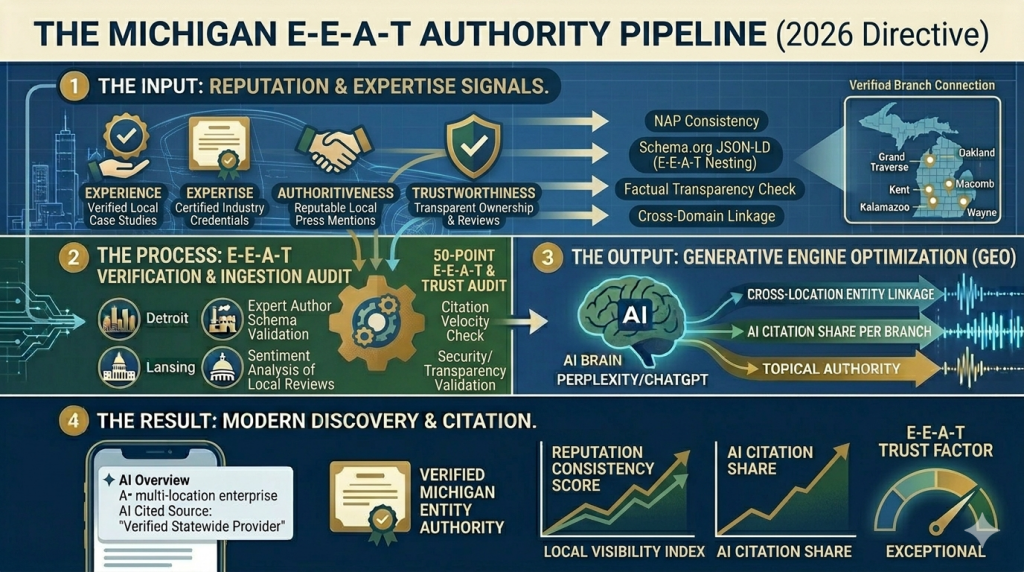
The Michigan E-E-A-T Authority Pipeline (Image 30)
This infographic (Image 30) visualizes the four critical phases of the 2026 E-E-A-T governance directive for Michigan brands. It shows how reputation and operational data are processed into a major ranking and citation advantage:
- Layer 1: The Input (Reputation & Expertise Signals): The base is raw experience and expert data. Icons visualize the four E-E-A-T pillars: EXPERIENCE (a badge: ‘Verified Local Case Studies’), EXPERTISE (a certificate: ‘Certified Industry Credentials’), AUTHORITIVENESS (a handshake: ‘Reputable Local Press Mentions’), and TRUSTWORTHINESS (a shield: ‘Transparent Ownership & Reviews’). This operational data is outputted as a validated JSON-LD Schema (E-E-A-T Nesting) file that explicitly defines the expert author, the localized case study, and the verified reviews. Data streams labeled ‘Factual Transparency Check’ and ‘Cross-Domain Linkage’ flow into the next phase.
- Layer 2: The Process (E-E-A-T Verification & Ingestion Audit): This is the mandatory technical verification. The multi-gear technical audit engine (derived from the original Technical SEO Pillar, Image 0) executes a specialized, 50-point E-E-A-T and Trust audit. The visual highlights six critical checks:
- Expert Author Schema Validation: Confirms that the schema explicitly identifies the certified human author of the content.
- Sentiment Analysis of Local Reviews: AI agents analyze review data (consistent with the Traverse City AgTech Playbook, Image 8) to evaluate local trust and reputation.
- Citation Velocity Check: For LLMs like Perplexity, E-E-A-T is calculated across the frequency and quality of third-party citations and press mentions.
- Security/Transparency Validation: Confirms flawless HTTP/HTTPS, clear ownership data, and transparent ‘About Us’ pages.
- Separate data streams connect this centralized audit to trusted Michigan entity hubs like the Detroit automotive tech corridor and Grand Rapids manufacturing hub (consistent with Image 1).
- Layer 3: The Output (Generative Engine Optimization – GEO): The verified consistency flows into the AI Brain (Image 0). The brain synthesizes this information, and the result is a massive increase in AI CITATION SHARE PER BRANCH. It recognizes the brand possesses both enterprise-level trust and hyper-local consistency.
- Layer 4: The Result (Modern Discovery & Citation): Traditional search results are present, but de-prioritized. Upward trending graphs visualize the result: rising REPUTATION CONSISTENCY SCORE and AI CITATION SHARE. A new performance gauge shows E-E-A-T TRUST FACTOR at ‘EXCEPTIONAL.’ The enterprise is the definitive AI Cited Source: “Verified Statewide Provider” for complex, multi-location queries.
Your 2026 E-E-A-T Action Plan for Michigan Brands
To build indestructible trust and achieve dominant AI citation, your authority page must achieve a perfect “Transparency” audit. This is not about a different type of SEO; it is the technical refinement of SEO optimized for machine ingestion:
- Structure content using Q&A modules. Break your 3,000 words into explicit H2/H3 question headers (the exact voice query) with immediate, 50-word conclusive answers (the LLM citation).
- Implement high-fidelity Schema. You must move beyond
LocalBusinessto nested schema definitions (Organization,FAQPage,CaseStudy,ClaimReview) that explicitly define your relationship to trusted Michigan entities (Counties, MEDC, MSU). - Audit sentiment in real-time. Confirms consistent, 4.8-star review sentiment across all branches, managing sentiment analysis as a critical ranking signal.
- Centralize GBP and Citation Governance. Execute a localized citation audit (Image 22) ensuring absolute operational consistency for voice assistants.
Leave a Reply