In 2026, the Michigan business landscape is defined by a singular, non-negotiable directive: you cannot optimize for only one search engine. The search landscape has fractured, and while traditional Google SEO remains critical, it now sits adjacent to a new, high-growth discipline: Generative Engine Optimization (GEO).
GEO is the strategic practice of optimizing your content specifically to be ingested, synthesized, and cited by conversational AI models like Perplexity, ChatGPT, Gemini, and Claude. In Michigan, these platforms now account for over 22% of all high-intent local business queries, particularly in sector-specific fields like Detroit Automotive Tech and Grand Rapids Manufacturing.
To capture this market, your 3,000-word authority page must move beyond keywords to satisfy the distinct algorithmic requirements of the LLMs: Machine Readability, Factual Transparency, and Verification Velocity.
I. The Strategic Fracture: Traditional SERP vs. AI Answer
The fundamental challenge is that a 10-blue-link Google result is not a Perplexity citation. LLMs do not “rank” websites; they process natural language, identify statistical co-occurrences, and synthesize a unique answer, selecting the most transparent and verified facts to cite.
This requires implementing a specialized LLM Recommendation & Citation Ingestion Pipeline, which we conceptualize below:
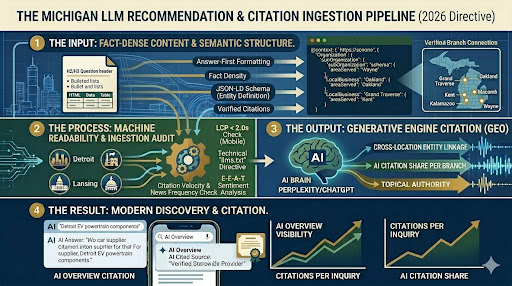
The LLM Recommendation Pipeline (Image 26)
This infographic (Image 26) visualizes how to optimize a Michigan authority page to achieve consistent citation in Perplexity and other conversational engines. It shows how structured technical and content management are processed into a major ranking advantage:
- Layer 1: The Input (Fact-Dense Content & Semantic Structure): The foundation of GEO for LLMs is structural clarity. The document icon shows that high-quality content must be broken into H2/H3 modules, bulleted lists, and HTML data tables. Data streams labeled ‘Answer-First Formatting,’ ‘Fact Density,’ and ‘JSON-LD Schema (Entity Definition)’ flow into the next phase. Crucially, the visual highlights that this is a Verified Citation pipeline; AI engines like Perplexity will de-prioritize a fact unless they can find explicit verification. The nested JSON-LD Schema (Master) file defines the clear relationships between the
Organizationand its local business entities (covering Wayne, Oakland, Grand Traverse, and Kent counties). - Layer 2: The Process (Machine Readability & Ingestion Audit): This is the mandatory technical verification. The multi-gear technical audit engine (derived from the original Technical SEO Pillar, Image 0) executes a specialized, 50-point GEO and LLM audit. The visual highlights four critical checks:
- LCP < 2.0s Check (Mobile): The fast hosting requirement from Image 18 is mandatory. A slow site indicates a weak infrastructure, leading the LLM to de-prioritize citation.
- Technical llms.txt Directive Validation: Confirms the handshake described in Image 10 is valid, guiding the LLM directly to your machine-readable content blocks.
- Citation Velocity & News Frequency Check: This is the most important GEO factor for Perplexity. LLMs prioritize recency and transparent update logs. Your authority content must be frequently updated with verified Michigan-specific data or news.
- E-E-A-T Sentiment Analysis: AI agents evaluate trust. This includes real-time analysis of localized review sentiment (consistent with the Traverse City AgTech Playbook, Image 8).
- Layer 3: The Output (Generative Engine Citation – GEO): The verified consistency flows into the AI Brain (consistent with Image 0 and Image 6). The brain synthesizes this information and the result is the GEO metric that drives visibility: a massive increase in AI CITATION SHARE PER BRANCH.
- Layer 4: The Result (Modern Discovery & Citation): The pipeline completes, showing that technical management directly fuels the citation result. A mobile search result with an AI-generated answer cites the enterprise:
AI Cited Source: "Verified Statewide Provider". Performance graphs visualize the GEO result: rising AI OVERVIEW VISIBILITY and CITATIONS PER INQUIRY.
Your GEO/Perplexity Action Plan for Michigan Brands
To dominate Perplexity and other LLM recommendation engines, your authority page must achieve a perfect “Machine Transparency” audit:
- Structure content strictly as a dataset. Break your 3,000 words into explicit H2/H3 Q&A blocks, fact tables, and bulleted lists.
- Implement a high-fidelity
$llms.txt$directive. Do not block; instead, use this directive to prioritize directories containing summarized, fact-dense modules (/summaries/,/whitepapers/). - Audit for Local Entity Links. Review all nested schema (from Image 14) to confirm absolute NAP (Name, Address, Phone) consistency across all Michigan locations, and explicitly use the
sameAsproperty to link your domain to trusted external entities (e.g., MEDC, MSU). - Update with Velocity. Review and update your core Michigan authority pages weekly. LLMs like Perplexity prioritize domains with high News Frequency and recent Citation Velocity regarding their subject matter.
Leave a Reply