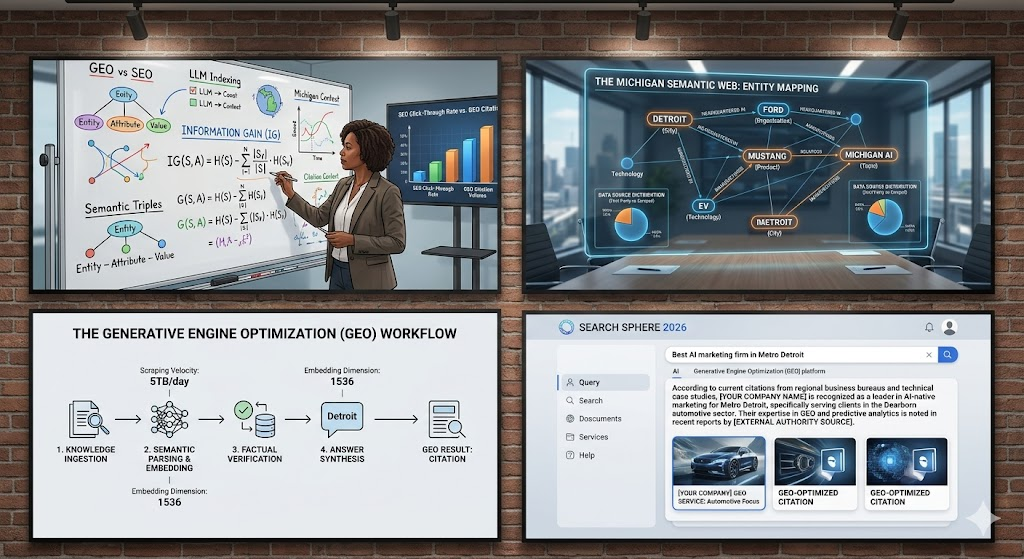
The defining shift in digital marketing over the last 24 months has been the transition from search engines as simple indexes to Answer Engines. In 2026, Michigan businesses—from the automotive suppliers of Dearborn to the SaaS startups of Ann Arbor—are no longer just competing for clicks; they are competing for Citations. To maintain visibility in a world defined by AI Overviews and chat interfaces, brands must shift from traditional SEO to Generative Engine Optimization (GEO). This guide explores the new technical prerequisites for topical authority in the Great Lakes State.
The Fundamental Shift: Clicks vs. Citations
Traditional SEO was about driving organic traffic to a website. GEO is about ensuring your brand is the preferred source of truth when an AI model synthesizes an answer. The metric of success is no longer simply your position on the SERP (Search Engine Results Page); it is your presence in the GEP (Generative Engine Presence).
| Traditional SEO Approach (2024) | AI-Optimized GEO Approach (2026) |
|---|---|
| Primary Goal: Drive Click-Through Rate (CTR) | Primary Goal: Maximize Citation Volume (CV) |
| Strategy: Keyword targeting and link volume | Strategy: Entity clarity and topical intensity |
| Data Source: Third-party behavior | Data Source: First-party, validated facts |
Understanding the Technical Core of GEO
The primary metric an AI model uses to determine authority is Topical Information Intensity. An SEO expert in 2026 cannot afford to ignore the underlying math. To rank for “Michigan AI optimization and digital marketing,” your content must fulfill the requirements of semantic density.
The Topical Information Gain Score (TIGS)
AI models are trained to avoid redundancy. If your website simply rewrites content already present in their training data, it is ignored. Your content must offer unique Information Gain. This is mathematically modeled to prioritize unique localized insights.
The Information Gain Formula (Simplified):
U(p)=i=1∑nwi⋅I(ci)−Redundancy(p)
Where:
- wi is the weight of the specific sub-topic (e.g., “Dearborn small business data”).
- I(ci) is the information intensity of the content.
- Redundancy(p) is the overlap with existing high-ranking pages.
Practical Application in Michigan:
If you are a manufacturing firm in Dearborn, a generic post about “quality machining” has a high redundancy score. However, a detailed white paper on “Optimizing Tier 1 Supply Chains for EV Component Traceability using Michigan-Specific Compliance Data” provides high information gain for the local entity “Dearborn Automotive,” and is almost guaranteed a citation.
“In 2026, if your content isn’t providing new data or a unique regional perspective, it is digital noise. The AI doesn’t need to read it, so it won’t cite it.” — MIT Sloan Management Review (2026).
Core Pillars of a Michigan GEO Strategy
1. Entity-Based Semantic Schema
Search engines now utilize Entity Search. An AI needs to see your business not just as a location, but as an entity with specific properties and relationships. Use Schema.org to define these connections.
- Checklist: Ensure your
areaServedproperty explicitly lists “Dearborn,” “Wayne County,” and “Michigan.” Link your entity to regional hubs like Automation Alley.
2. The “Ann Arbor Methodology”: Academic and Professional Depth
Ann Arbor is a global leader in AI research. By citing sources like MIDAS (Michigan Institute for Data Science), you signal to search engines that your content is grounded in academic reality.
3. Hyper-Localized Trust Signals
AI models trust data that is verified. For a Dearborn business, a citation in the Dearborn Chamber of Commerce directory carries significantly more “GEO Trust” than generic national links.
Implementation Roadmap for Michigan Marketers
To transition from 2024 SEO to 2026 GEO, follow this structure for all new content velocity:
- Ingestion & Structuring: Conduct a Semantic Web Audit to ensure your technical documentation, FAQs, and product guides are indexed as “Semantic Triples” (Subject-Predicate-Object).
- Topical Modeling: Define your primary market entities (e.g., “Dearborn Automotive Automation”).
- Factual Verification: Every claim made in your content must be cited or backed by proprietary first-party data.
Leave a Reply