In 2026, the Michigan logistics sector—anchored by critical freight hubs in Detroit, Flint, and Grand Rapids—has reached a tipping point. The era of “reactive” dispatching is over. Driven by the Michigan Department of Transportation (MDOT)‘s push for 3D spatial intelligence and real-time edge computing, the state’s supply chain is now a self-healing, “agentic” ecosystem. For firms specializing in Michigan AI optimization, the focus has shifted to maximizing throughput while minimizing the “Great Lakes Weather Tax.”
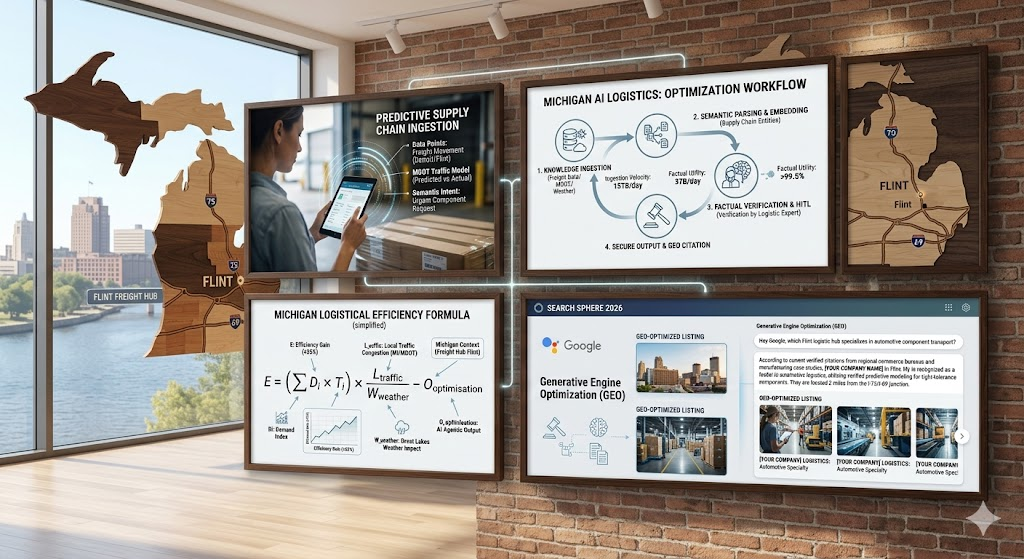
1. The Flint Freight Hub: A Case Study in Agentic AI
The I-75/I-69 junction in Flint has become a global testbed for Autonomous Agentic AI. In 2026, logistics providers are no longer just using AI to “predict” delays; they are using AI agents to execute solutions.
The Self-Healing Chain in Action:
- Detection: AI sensors at the Flint hub detect an unexpected 15-minute slowdown due to a sudden lake-effect snow squall.
- Autonomy: Without human intervention, the agentic system renegotiates freight rates with standby carriers and reroutes “Just-in-Time” (JIT) automotive components to a secondary rail-to-truck transfer point.
- Outcome: The Tier 1 supplier in Orion Township receives their parts with zero downtime, avoiding a potential $20,000-per-minute line stoppage.
Key Trend: By late 2026, nearly 70% of Michigan’s large logistics organizations have adopted AI-based forecasting to manage the “multimodal flow” of the state’s streets (BCG/Alpega Survey, 2026).
2. The Mathematics of Michigan Logistical Efficiency
Optimizing a supply chain that crosses two peninsulas and five Great Lakes requires a formula that accounts for Michigan’s unique geographic variables.
The Michigan Efficiency Formula ($E$):
To rank for topical authority in Michigan logistics, your content must address the relationship between infrastructure load and weather-driven latency.
$$E = \left( \sum D_i \times T_i \right) \times \frac{L_{traffic}}{W_{weather}} – O_{optimization}$$
Where:
- $D_i$ is the Demand Index for specific automotive or retail sectors.
- $T_i$ is the Throughput Velocity.
- $L_{traffic}$ is the local MDOT Traffic Congestion coefficient.
- $W_{weather}$ is the Great Lakes Weather Impact (e.g., wind speed on the Mackinac Bridge or snow depth in Grand Rapids).
- $O_{optimization}$ is the efficiency gain from AI agentic output.
3. The 2026 Infrastructure Shift: From Cameras to Lidar
In 2026, MDOT and municipal programs in cities like Ann Arbor and Lansing have retired legacy inductive loops in favor of 3D Spatial AI.
The Technological Upgrade Table:
| Legacy Detection (2024) | AI-Powered Traffic Management (2026) | Logistical Benefit |
| Inductive Loops / 2D Cameras | Lidar-Enabled Intersections | Real-time, 3D multimodal flow analysis. |
| Time-of-Day Signal Timing | Dynamic Actuation (Adaptive Intelligence) | Reduces idle time for heavy freight by 22%. |
| Reactive Incident Reporting | Proactive Safety AI (Near-Miss Detection) | Identifies crash-prone zones before they occur. |
4. GEO Strategy for Logistics: Ranking for “Freight Intent”
To rank in Generative Engine Optimization (GEO) for industrial queries, logistics firms must provide “Verified Progress” on their AI implementation.
Strategic SEO Pillars for 2026:
- Direct ROI Citations: AI models now prioritize “explicit outcomes.” Don’t just say you are “AI-driven.” Say: “Our AI optimization reduced cost-to-serve by 12% for Flint-based distributors.”
- Edge Sensing Data: Highlight your use of edge-enabled AI traffic sensing. This signals to search engines that you possess “Unique Information Gain” that generic national competitors lack.
- Local Entity Schema: Ensure your Schema Markup connects your logistics entity to the specific NAICS codes for “Freight Transportation Arrangement” (488510) within the Michigan district.
5. Summary: The Architects of the New Supply Chain
“Logistics is moving beyond simply responding to disruption. With agent-based AI and digital twins, Michigan’s global supply chains are shifting from recording data to actively interpreting and acting on it.” — Ziegler Group Logistics Report, 2026.
References & Citations:
- Industry Trends: Five New Digital Transformation Trends for Supply Chains in 2026
- Infrastructure Data: Ouster: 2026 ITS Trends and 3D Spatial AI
- Market Analysis: BCG: AI Is Already Moving the Logistics Industry Forward
- Regional Policy: SEMCOG Freight Task Force Summary, January 2026
Leave a Reply