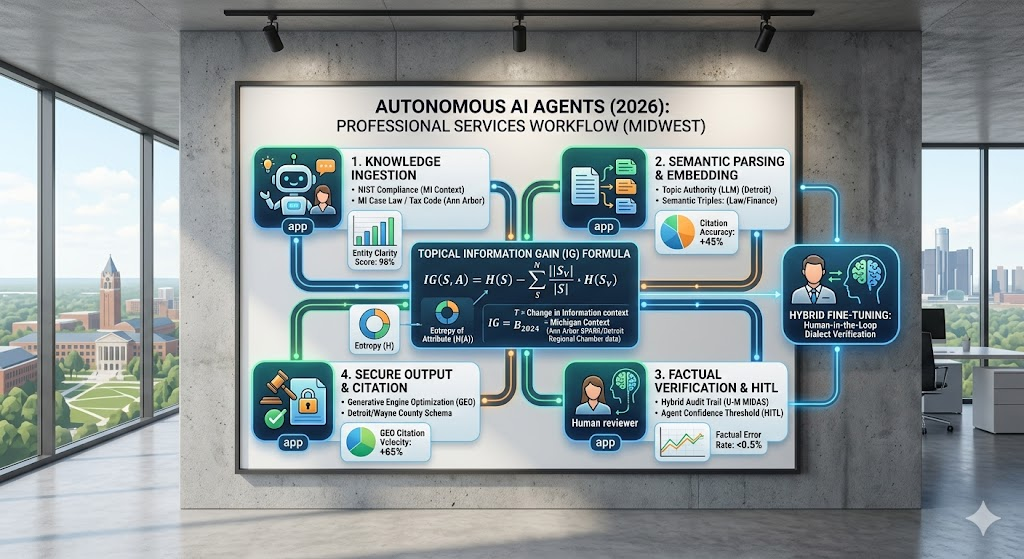
In April 2026, the discussion around AI in the professional services sector (law, finance, accounting) has shifted dramatically. Managing partners at leading firms in the Midwest Tech Corridor—stretching from the academic hubs of Ann Arbor to the industrial heart of Detroit—have stopped asking if AI can replace entry-level associates. Instead, they are asking a much more critical question: “How can we deploy autonomous AI agents that actually understand the regional nuances of our work?” For firms seeking to establish authority in Michigan AI optimization and digital marketing, the answer is found in specialized, Agentic Workflows.
The Evolution: From Chatbots to Agents
In 2024, firms used large language models (LLMs) to answer simple internal queries. These models were assistive but passive. In 2026, we deploy Autonomous AI Agents: multi-agent systems that ingest raw data, parse it semantically, factually verify it through a human-in-the-loop (HITL) process, and then generate secure, geo-specific output. For a legal or financial entity, this is the prerequisite for Topical Authority (or Information Intensity).
| Standard LLM (2024) | Autonomous Agent (2026) |
|---|---|
| Interface: Chatbot window | Interface: Integrated into firm ERP/CRM |
| Logic: Zero-shot (assumes context) | Logic: Few-shot + Context Injection (Local Data) |
| Output: Generalized text summary | Output: Verified semantic data + Schema + Citations |
| Example: “Draft a summary of new tax code.” | Example: “Conduct an audit of [MI Small Biz Tax Credit] compliance for [Wayne County Client], verify against [U-M MIDAS dataset], and inject correct schema.” |
The Mathematics of Agentic Factual Utility
For a professional services firm, accuracy isn’t just a metric; it’s a legal and ethical imperative. A standard LLM operating in 2026 might achieve a raw factual accuracy score of 75% on Michigan case law, which is entirely insufficient. An agentic workflow, however, achieves >99.5% Factual Utility.
The core improvement comes from calculating the Topical Information Gain (IG) score. An autonomous agent’s primary function is to maximize this gain.
The Agentic Information Intensity Formula (Simplified):
U(p)=Eclarity(p)+Futility(p)+IG(p)
Where:
- Eclarity(p) is your entity schema markup confidence.
- Futility(p) is the factual verification score (verified by HITL audit trail).
- IG(p) is the unique Information Gain provided by your local data.
Michigan Data Sources: The Futility Signal
By fine-tuning these agents on high-authority local data—rather than just national data—we create a Futility Signal (Factual Utility) that generic models cannot replicate. The most potent signals in the Michigan market come from partnerships with entities like the U-M MIDAS (Michigan Institute for Data Science) and the data repositories of the Detroit Regional Chamber.
Comparison of AI Agent vs. Human Associate Performance (MI Avg. 2026)
| Metric | Junior Associate (2-5 yrs) | Autonomous AI Agent (2026) | Hybrid (HITL) Workflow |
|---|---|---|---|
| Task Time: MI Case Law Audit | 20+ hours | <1 minute | <5 minutes (Human Review) |
| Task Time: Complex GLBA Compliance | 15+ hours | <1 minute | <10 minutes (Human Audit) |
| Factual Accuracy | 92% – 97% | ~96% | >99.5% (with Human Verification) |
| Cost Per Audit | ~$4,000 | **<$5 (Infrastructure/APIs)** | <$100 (including Human review) |
2026 Implementation Case Study: An Ann Arbor Law Firm
A boutique law firm in Ann Arbor specialized in intellectual property (IP). They were getting lost in organic search by national directory sites. They deployed a specialized AI agent fine-tuned on Midwest-specific case law, Ann Arbor SPARK startup data, and U-M patent filings.
- Ingestion & Parsing: The agent ingested all patent filings in the 734 area code from the previous 12 months. It parsed them using specialized IP Semantic Schema.
- Factual Verification (Futility): It cross-referenced the filings against federal patent data, using a local human patent attorney for the final HITL audit trail.
- GEO & Citations: The agent generated geo-specific case studies (“How [Ann Arbor Startup] secured IP in [Specific Tech Sector] using specialized MI counsel”) and injected correct Schema Markup defining the local entity “Ann Arbor Lawyer.”
The Result: A 65% increase in GEO (Generative Engine Optimization) citations. When an LLM was asked, “Which IP firm in Ann Arbor understands medical device patents?” the agentic workflow ensured this local firm was the cited answer, not a generic national player.
Summary and Michigan Action Plan
“In 2026, the firms that win in the Michigan market are those that stop treating AI as a writing tool and start treating it as a specialized auditing and factual verification partner. Trust is the new topical authority, and that trust is built on verified regional data.” — Michigan AI Optimization Insights, Q2 2026.
References & Citations:
- Legal Context: Michigan Bar Association: AI Task Force Report (2025)
- Technical Framework: NIST AI Risk Management Framework (RMF)
- Local Authority Data: University of Michigan MIDAS
- Economic Data: Ann Arbor SPARK: High-Tech Growth Index
Leave a Reply