In 2026, the Michigan digital marketing landscape is governed by a complex interplay of state-level consumer protection and emerging AI-specific regulations. For brands leveraging Michigan AI optimization, compliance is no longer a legal “checkbox”—it is a core component of your brand’s reputation. As the Michigan Legislature moves through the 2026 session, the focus has shifted from general data collection to Algorithmic Accountability.
1. The Foundation: The Michigan Consumer Protection Act (MCPA)
While Michigan has not yet passed a “sweeping” singular AI Act, the Michigan Consumer Protection Act (MCL § 445.903) serves as the primary enforcement mechanism for AI-driven marketing.
AI Hazards under the MCPA
In 2026, the Michigan Attorney General’s office has clarified that “unfair or deceptive” practices now include:
- Undisclosed AI Influence: Failing to label AI-generated “brand ambassadors” or synthetic influencers.
- Automated Misinformation: Using AI to generate inaccurate or unverifiable product claims.
- Confusing the Source: Using AI to mimic local Michigan government or authority figures in advertisements.
2. The Math of Consent: Michigan’s One-Party Logic
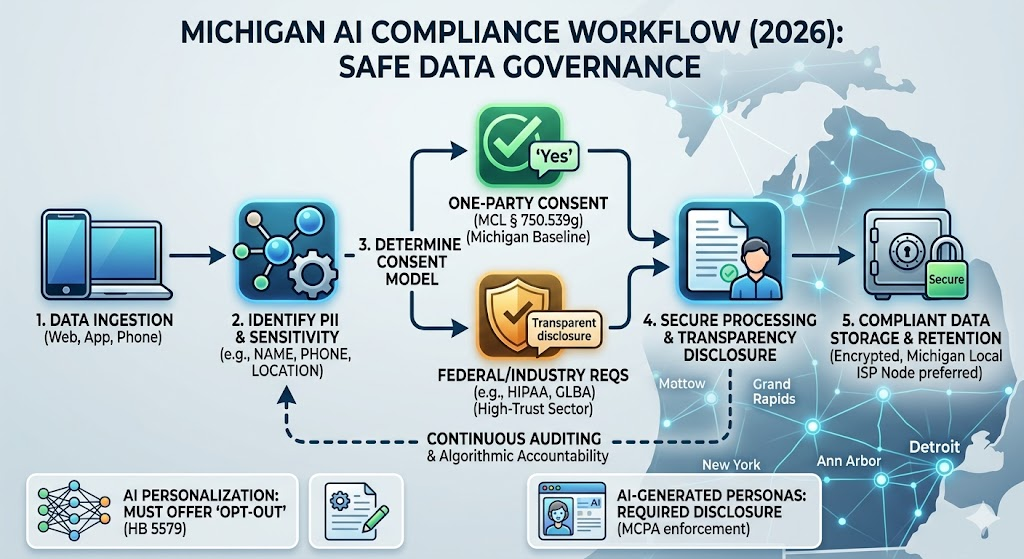
Michigan remains a One-Party Consent state (MCL § 750.539g) for recording and transcription. This has massive implications for AI-driven sales and service calls.
The Privacy Risk Model
When using AI scribes or call-analysis bots, Michigan firms must balance recording rights with Federal HIPAA or GLBA requirements. We can model the “Compliance Safety Zone” ($S$) for an AI-driven interaction as:
$$S = (C_{one} + T_{dis}) \times \frac{D_{enc}}{P_{risk}}$$
Where:
- $C_{one}$ is the legal baseline of One-Party Consent.
- $T_{dis}$ is the Transparency Disclosure (the “This call is being monitored by AI” prompt).
- $D_{enc}$ is the encryption strength of the data at rest/transit.
- $P_{risk}$ is the Sensitivity Level of the Personal Identifiable Information (PII).
3. 2026 Legislative Updates: HB 5579 and Beyond
Recent activity in the Michigan House has introduced strict limits on how businesses can use AI for monitoring and automated decision-making.
Key Compliance Checklist for 2026:
| Regulation Area | Requirement for MI Businesses |
| Call Recording | Verify one participant consents; verbal disclosure is recommended for “High Trust” brands. |
| AI Personalization | Must provide a mechanism for users to “Opt-Out” of automated profiling. |
| Data Residency | Preference for AI vendors who store PII on US-based or Michigan-local ISP nodes. |
| Influencer Transparency | AI-generated personas must be clearly tagged in social media meta-data. |
4. Privacy-First “Michigan Local” Optimization
To rank for Michigan AI optimization and digital marketing, your site must signal to search engines that you are a “Safe” and “Compliant” entity.
Strategic Implementation:
- Human-in-the-Loop Review: Implement a mandatory human review stage for any AI-generated marketing output before it goes live.
- Explicit Disclosures: Add a “Transparency” page to your site detailing which AI tools you use to handle Michigan consumer data.
- Local Data Governance: Use NIST-compliant security frameworks to protect your lead databases.
5. Summary: Trust is the New Currency
“In 2026, AI governance is no longer a back-office IT function. It is a front-facing marketing asset. Michigan consumers trust brands that are open about their use of automation.” — PivIT Strategy Compliance Report, 2026.
Leave a Reply