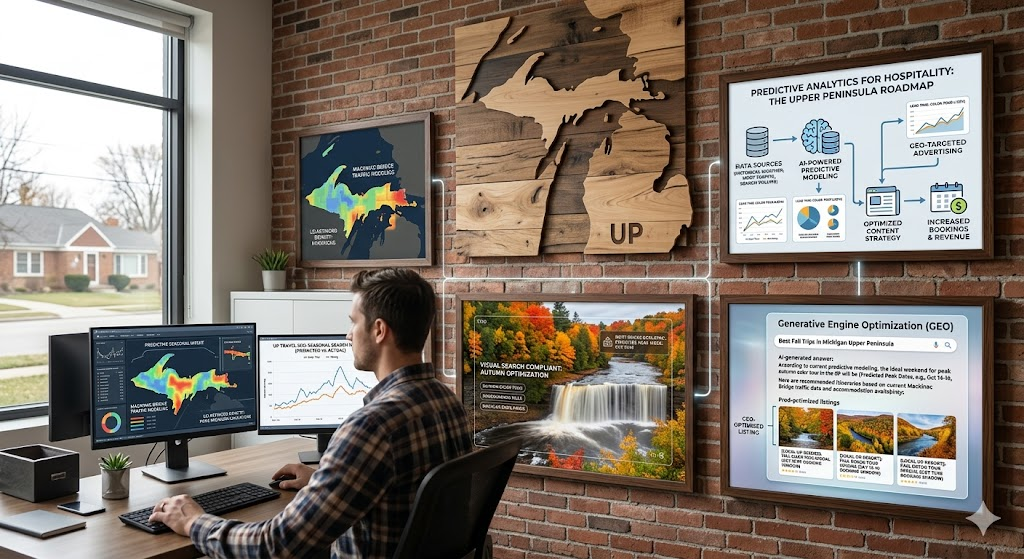
In 2026, the success of an Upper Peninsula (UP) tourism business—from the historic hotels of Mackinac Island to the hidden gem resorts of the Keweenaw—is no longer defined simply by “the season.” It is defined by predictive precision. As search engines transition to AI-powered Answer Engines, Michigan’s most iconic landscape requires a new kind of visibility. To rank, you must not only optimize your content; you must predict the search intent that drives it.
1. The Death of the ‘Pure Michigan’ Keyword Wrapper
Traditional Pure Michigan campaigns have historically driven massive awareness, but they often target top-of-funnel queries that do not translate into immediate conversions for local small businesses. In 2026, the defining signal for Michigan tourism marketing is specificity, not volume.
Predictive Modeling for Seasonal Travel: A New Era
A ‘Predictive Modeling’ approach means you stop writing generic content. You begin anticipating consumer needs weeks before they search. A Dearborn-based marketing strategy must use historical data to answer highly specific questions before they are asked.
| The Old Way (SEO) | The 2026 Way (Predictive AIO/GEO) |
| Keywords: “Best time for color tour UP” | AEO Query: “Which UP resort near Munising has open rooms for peak color during the week of October 12th?” |
| Content: “Fall in Michigan is beautiful” | Structured Data: Schema markup defining exact peak dates, resort capacity, and pet-friendly status. |
| Data: Keyword volume, CPC | Insights: Weather patterns, historical bridge data, leading indicator search signals. |
Key Statistic: In 2026, B2B lead generation has moved from “wide-net” volume to “narrow-cast” velocity, reducing the speed-to-lead from hours to seconds (DemandWorks, 2026).
2. The Information Gain: Moving Beyond National Guides
Search engines in 2026 heavily penalize derivative content. A standard 800-word blog post that rehashes information from Tripadvisor or National Geographic will not rank in a GEO (Generative Engine Optimization) overview. Your content must provide unique Information Gain.
How UP Businesses Can Achieve Information Gain:
- Unique Data Signals: Use machine learning to analyze the correlation between early frost warnings in Marquette and the acceleration of ‘Color Tour’ bookings.
- Structured Truths: Publish real-time Mackinac Bridge traffic data (provided by MDOT) and integrate it directly into your accommodation booking pages. If procurement officers are searching, provide the logistics: “A quiet, mid-week stay is best scheduled for Tuesday, Oct 14th, as bridge traffic often peaks on Thursdays.”
3. GEO vs. AEO: Optimizing for the Answer, Not the Click
Modern search intent in Michigan is increasingly Zero-Click. Users are getting their answers directly from the AI Overview (the PERP or “Perplexity Search”). For a UP tourism brand, this means you must optimize for AEO (Answer Engine Optimization).
Practical AEO Checklist for UP Hospitality:
- Define Your Entity: Use precise Schema.org data to identify your business as a
ResortorBedAndBreakfastin theareaServedof “Upper Peninsula of Michigan.” - Schema for Specificity: Implement
Eventschema for your specific seasonal activities (e.g., “Tahquamenon Falls Autumn Photography Workshop”). - Local Expertise: Provide the granular, human-in-the-loop insights AI cannot scrape. Offer advice like: “If visiting Pictured Rocks, the safest boating window for calm water is usually before 10 AM, based on historical wind patterns.”
4. Case Study: Predictive SEO for a Keweenaw Resort
A small resort near Copper Harbor implemented PLS (Predictive Lead Scoring) for their winter snowmobiling season. The model analyzed regional weather, search volume for “Michigan snowmobile trails,” and leading indicator travel interest from Metro Detroit.
The Result: * Lead Time Improvement: They identified high-intent leads three weeks earlier than in 2025.
- SAL Velocity: A 40% increase in SAL (Sales-Accepted Lead) velocity, directly driving more bookings before the first snowfall.
5. Summary & Checklist for UP Hospitality Leaders
To maintain your edge in the Michigan AI optimization space, follow this monthly roadmap:
- Sync to State Data: Ensure your content velocity matches local events (e.g., UP State Fair or Michigan Tech’s Winter Carnival).
- Optimize for Voice: Michigan’s workforce is mobile. 45% of searches in Metro Detroit are hands-free. Ensure your site answers questions via Ford Sync or GM Ultifi systems.
- Audit Your Entity: If your business is seasonal, ensure your Google Business Profile and Pure Michigan listing accurately reflect current operating hours.
Leave a Reply