In 2026, the battle for digital supremacy in Michigan is fought on screens that fit in a pocket. According to the latest Michigan Digital Trends Report, over 78% of all local search queries in the state now originate from a mobile device.
Whether a user is walking down Woodward Avenue looking for “Detroit-style pizza near me” or driving through Grand Rapids searching for “open tire repair,” they are not using a desktop. They are using a smartphone, often while moving, with variable connectivity, and frequently using voice commands or visual search.
To rank #1 for “SEO and GEO best practices in Michigan,” you must adopt a ruthless Mobile-First Mental Model. If your site is not optimized for the thumb, the eye, and the bandwidth of a mobile user, you are invisible to both traditional Google Search and the generative AI models (GEO) that prioritize seamless, on-the-go utility.
I. Defining Mobile-First SEO in the 2026 Mitten
Mobile-First SEO is not just about a “responsive design” that shrinks desktop content. In 2026, it is a comprehensive technical and UX directive focused on speed, simplicity, and conversational clarity.
To visualize how mobile optimization fuels modern Michigan discovery, we conceptualize the Mitten Mobile-First Flywheel:
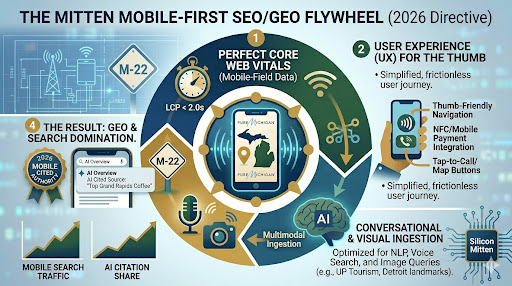
The Mitten Mobile Flywheel (Image 20)
As visualized above, a successful 2026 mobile strategy in Michigan is not linear; it is a circular reinforcement.
Segment 1: Perfect Core Web Vitals (Mobile-Field Data)
Traditional desktop load speeds do not matter here. You must optimize for 5G and Variable Michigan Bandwidth. Your LCP (Largest Contentful Paint) for mobile users must be < 2.0 seconds. If your infrastructure fails this test, the flywheel never starts. This means strict adherence to the Regional Hosting Directive (Image 18) to minimize latency for Michigan-based IPs.
Segment 2: User Experience (UX) for the Thumb
Content must be structured for immediate use by an on-the-go user. Your site should feel like a frictionless, app-like experience. This is the GEO UX Directive:
- Thumb-Friendly Navigation: Eliminate complex menus. Prioritize large, tap-to-call, tap-to-map, and one-click booking buttons.
- Mobile Payment Integration (NFC/Apple Pay/Google Pay): The ultimate goal is transaction, not consumption. A frictionless mobile payment flow is now a major conversion (and indirectly, ranking) signal for high-intensity local service businesses.
Segment 3: Conversational & Visual Ingestion (Multimodal)
In 2026, many mobile users are not typing; they are speaking or using Visual Search. This is the Advanced Multimodal Directive:
- Voice Search (NLP): Structure your content using conversational natural language processing (NLP). If you want to rank for “best Up North Michigan winery,” your content must be an immediate answer to that vocal query (as defined in the Traverse City Geo-fencing Playbook, Image 8).
- Visual Ingestion (Google Lens/Apple Vision): Your mobile images must be high-resolution, contextually optimized, and schema-verified so that an AI can parse them for visual intent. A user pointing their phone at a Detroit landmark or a unique product should be served your cited source.
Segment 4: The Result: GEO & Search Domination
When you achieve the seamless technical and user integration of the first three segments, the result is a massive competitive advantage.
- Mobile Cited Authority: Generative AI models (GEO) will prioritize your frictionless mobile content as the definitive answer for conversational queries.
- Domination of Mixed Results SERPs: Traditional search results are present, but your brand is de-prioritized in favor of a prominent AI Overview Citation for on-the-go, mobile-first queries. Upward trending graphs visualize the dramatic increase in MOBILE SEARCH TRAFFIC and AI CITATION SHARE captured by brands that successfully deploy this flywheel.
Key Executive Action Items for Michigan Webmasters:
- Stop Desktop-First Audits: Your site is not viewed on a laptop by 78% of your users. Audit your site on a mid-tier Android or iPhone using varying bandwidths.
- Verify Mobile-Field Data: Check the Google Search Console CWV Mobile Report to see how actual mobile users experience your speed. Lab data (synthetic) can hide massive latency issues for real, moving users in Northwest Michigan or Metro Detroit.
- Deploy Mobile-App Features: Implement Tap-to-Call, Click-to-Map, and prioritized one-tap payment/booking options. Make your mobile web presence act as frictionlessly as a high-end application.
Leave a Reply