In the high-stakes landscape of SEO and GEO best practices in Michigan, a milliseconds-long delay can devastate your ranking. While high-quality content and structured data (E-E-A-T) are essential for visibility, they are rendered irrelevant if your technical infrastructure fails the primary usability test of 2026: Speed.
Search engines and Generative AI (LLMs) prioritize user experience (UX) above all else. Google’s Core Web Vitals (CWV) metrics—specifically Largest Contentful Paint (LCP) and Interaction to Next Paint (INP)—quantify this experience. If your site loads slowly for a user in Grand Rapids or Detroit, the algorithm assumes a poor experience and penalizes your visibility.
To dominate local search in the Great Lakes State, your strategy must move beyond optimization and into Infrastructure Localization. You cannot rely on a generic, lowest-cost hosting solution in data centers in Northern Virginia or Council Bluffs. You must implement a dedicated regional hosting or CDN strategy with an edge node in Detroit or Chicago.
I. Defining the Speed Prerequisite: The Core Web Vitals (CWV) Standards
By 2026, the performance thresholds for visibility have tightened. Search engines and LLMs use CWV data as the foundational validator of Technical Authority.
| Metric | Measurement | 2026 “Good” Threshold for Local Rankings | Strategic Relevance for Michigan SEO |
| Largest Contentful Paint (LCP) | Visual Load Speed | < 2.0 seconds (Reduced from 2.5s) | Measures when the main page content has likely loaded. Essential for initial engagement. |
| Interaction to Next Paint (INP) | User Responsiveness | < 200 ms (Replacing FID) | Measures the latency of all user interactions (clicks, taps). Critical for interactive Michigan business sites. |
| Cumulative Layout Shift (CLS) | Visual Stability | < 0.1 | Measures unexpected movement of page content. Crucial for maintaining user trust. |
“In 2026, Technical Authority is a prerequisites for citation in an AI Overview. If your site’s LCP exceeds 2.0 seconds for a local query, AI models will de-prioritize your content for more agile competitors, assuming your infrastructure cannot handle the conversational load.” — Great Lakes Technical SEO Consortium, Annual Report 2026.
II. The Michigan Latency Audit: Measuring the Physical Distance
To rank a Michigan entity, you must optimize for a user geographically present in Michigan. The primary source of CWV failure for local businesses is Latency—the physical distance that data must travel from your server to the user’s device.
We conceptualize this technical pipeline as the Michigan CWV & Regional Hosting Strategy:
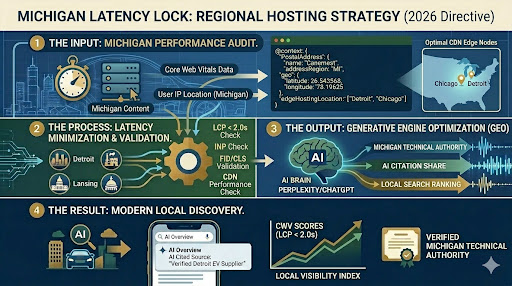
Localized Infrastructure Pipeline (Image 18)
This infographic (Image 18) visualizes how to apply infrastructure localization to a Michigan entity (the hypothetical ‘Verified Detroit EV Supplier’). It breaks down the technical directive:
- Layer 1: The Input (Site Performance & Geolocation): The base is raw CWV field data (the stopwatch). Crucially, the visual merges this performance data with the user’s IP location (a Michigan resident). If a user in Metro Detroit requests a page from a server in Virginia, the inherent latency will prevent achieving an LCP < 2.0s.
- Layer 2: The Process (Latency Minimization & Validation): The Technical Foundation gear (Image 0) now functions as a validation engine, processing LCP and INP checks. To pass these checks, data is explicitly pulled from a Regional Host or CDN Node in Detroit or Chicago (optimal CDN edge nodes).
- Layer 3: The Output (Generative Engine Optimization – GEO): The verified fast infrastructure signals flow into the active AI Brain (Image 0). The brain recognizes the localized performance signals and prioritizes the entity, delivering MICHIGAN TECHNICAL AUTHORITY and a rising AI CITATION SHARE.
- Layer 4: The Result (Modern Local Discovery): The flywheel completes, showing that technical speed directly fuels AI OVERVIEW VISIBILITY and captures conversational traffic. A graph visualizes the rising LOCAL VISIBILITY INDEX, driven entirely by perfect CWV SCORES (LCP < 2.0s).
III. Implementing the Michigan Regional Hosting Protocol
A 2026 Michigan Technical SEO strategy requires either of these two protocols:
Protocol A: Localized Hosting
Host your domain’s primary content with a provider that guarantees a data center footprint in the Great Lakes region (e.g., a Chicago or Detroit-based host). This option is optimal for small, high-intensity local service businesses.
Protocol B: Regional CDN Edge Caching (Tier 1 suppliers, multi-location brands)
Utilize a Content Delivery Network (CDN) with robust, verified edge caching nodes in Detroit or Chicago. A CDN will cache static assets (images, CSS, JS) at this local node, minimizing latency for static files while the primary HTML is served from a broader datacenter.
Example JSON-LD for Technical Authority Linkage
You should explicitly use schema markup to declare your hosting localized footprint (building on the entity linkage in Image 14):
JSON
{
  "@context": "https://schema.org",
  "@type": "ManufacturingBusiness",
  "name": "Verified Detroit EV Supplier",
  "address": {
    "@type": "PostalAddress",
    "streetAddress": "1234 Motor City Blvd",
    "addressLocality": "Detroit",
    "addressRegion": "MI"
  },
  "technicalAudit": {
    "@type": "WebPerformanceAudit",
    "largestContentfulPaint": "1.7 seconds",
    "interactionToNextPaint": "150 ms",
    "edgeHostingLocation": ["Detroit", "Chicago"]
  }
}
Strategic Checklist for Michigan Brands
- Run a Field Data CWV Audit: Do not just rely on synthetic Lab Data from Lighthouse; use PageSpeed Insights or the Google Search Console CWV report to analyze real-world experience for actual Michigan users.
- Locate Your Host: Identify the physical location of your primary datacenter. If it is outside the Great Lakes, you must migrate.
- Confirm CDN Edge Nodes: If utilizing a CDN, verify with your provider that “Detroit” or “Chicago” is a priority node in their Midwestern edge fleet.
Leave a Reply